Easy Fresh Tomato Sauce Parma-Style

This Post May Contain Affiliate Links. Please Read My Disclosure

Easy Fresh Tomato Sauce, Parma, Italy-style, is a simple, flavorful way to preserve your tomato bounty for a delicious taste of summer all year long!
“Best and freshest sauce we have ever made … Will be making this sauce until my tomato plants are done! It’s that good y’all!”

Friends! We’re in tomato overload here, and I couldn’t be happier!
Tomatoes are extremely difficult to grow in the South, but this year, we did something right, and I owe it all to my hubby!
We enjoy so many things with our fresh tomatoes in the summer, including some of the recipes I recently shared with you. But one thing I really enjoy making is a good, basic fresh tomato sauce we can add to ANYTHING Italian-inspired we’re making this winter!
However, you may be asking yourself…
What is Parma-Style Tomato Sauce?

Well, Parma-Style Basic Fresh Tomato Sauce is how I have ALWAYS made my sauce, and it doesn’t involve peeling or seeding the tomatoes, which is always a project before the project!
As you know, I’m sort of a cookbook fanatic, and I like to pick up a cookbook from wherever I’ve been. A number of years ago, I had the opportunity to travel to Parma, Italy, with a group of my personal chef friends to attend a culinary school there. We had WAY too much fun that I’ll never forget.
I purchased a copy of Parma, A Capital of Italian Gastronomy by Giuliano Bugialli (Affiliate Link) there, and had all the chefs at the school sign it.
With our tomato bounty, I was looking for a new way to make tomato sauce. I grabbed this cookbook, saw one of his sauce recipes, and lo and behold, it was my OLD way of making tomato sauce! Very cool to have Giuliano Bugialli’s blessings!
What are the best tomatoes for tomato sauce?
- It’s best to use Roma or plum tomatoes (otherwise known as “paste” tomatoes). You can use any tomatoes or a combination, but some varieties of tomatoes contain A LOT of water, and you may be cooking it down for a while to get it thickened.
- The tomatoes should be ripe but not overly ripe, especially if you’re using a mix.

Let’s make it!
How to make Basic Fresh Tomato Sauce Parma-Style:
- Gather up and chop all the ingredients:
- Fresh tomatoes
- Onion
- Celery
- Carrots
- Garlic
- Fresh parsley
- Olive oil (DON’T USE IF PLANNING TO WATER BATH CAN)
- Fresh basil
- Add salt and pepper, too!

- Combine everything in a Dutch oven or other heavy-bottomed pot, except the fresh basil. No peeling or seeding the tomatoes is needed at this point!

- Cover and let everything break down and simmer until it resembles a thick tomato stew.
- Let that cool down a bit…

- Place this rough mixture into a food mill in batches.
- Turn the handle, forcing this “stew” through the food mill’s holes, leaving the seeds and skins behind while pushing all that wonderful flavor through.

- What you end up with is a lovely, delicious basic tomato sauce that has been flavored with the loveliness of carrot, celery, onion, garlic, and fresh herbs.

- Cook it down a little bit more with some fresh basil….
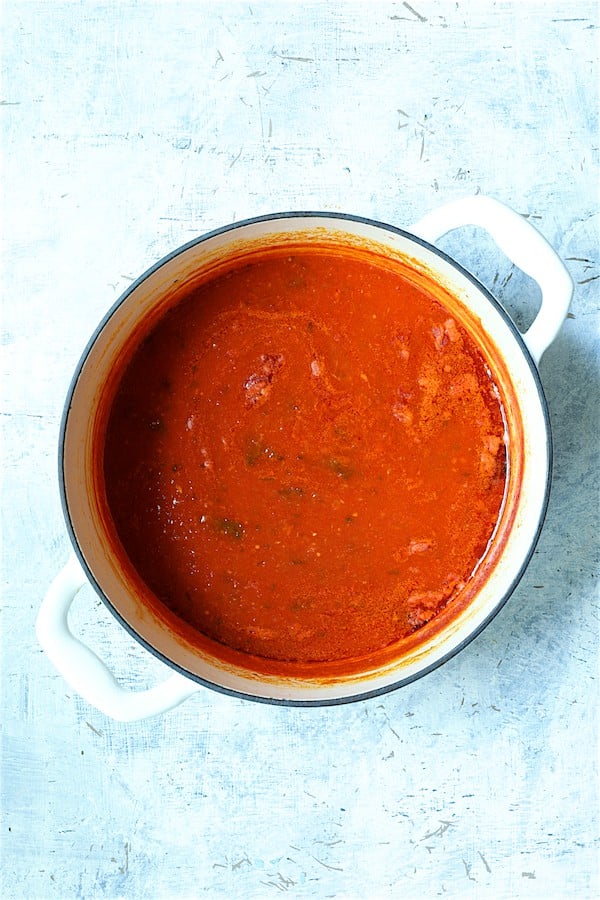
- And voila!

- A lovely basic fresh tomato sauce that you can use in a multitude of ways!
At this point, you can:
- Use it immediately!
- Freeze it. Ladle cooled sauce into freezer containers, cover, and freeze.
- Can it. Add 2 tablespoons of bottled lemon juice per quart jar or 1 tablespoon per pint jar. Ladle into sterilized glass Mason jars, leaving a half-inch headspace. Wipe the rims clean with a clean, damp paper towel. Place lids and rims on until just tight. Process jars in a water bath canner for 20 minutes. Carefully remove the jars from the water bath and let them sit undisturbed for 24 hours to ensure the lids seal.
That’s it! A lovely Basic Fresh Tomato Sauce Recipe, Parma-Style!
Use this fresh tomato sauce in:
- Middle Eastern Spiced Meatballs in Tomato Sauce
- Slow-Cooker Spicy Sausage and Pepper Ragu
- Italian Stuffed Peppers
- Spinach Feta Stuffed Turkey Meatloaf
- Gnocchi Puttanesca

Basic Fresh Tomato Sauce Parma-Style
Ingredients
- 5 pounds Roma tomatoes, ripe but not overripe (or a combination)
- 2 medium carrots, coarsely chopped
- 1 large onion, coarsely chopped
- 1 large stalk celery
- 6 cloves garlic, crushed
- 10 sprigs Italian parsley, leaves only
- 1/4 cup extra-virgin olive oil, LEAVE OUT IF WATER-BATH CANNING
- 1 teaspoon fine sea salt, plus more to taste
- 1 handful large basil leaves, torn into pieces
- lemon juice, IF CANNING
Instructions
- Cut tomatoes into large chunks and place in a Dutch oven or other heavy, thick-bottomed pot.
- Add the carrots, onion, celery, garlic, parsley, olive oil and salt.
- Bring to a simmer over medium-high heat. Reduce heat to low, cover and let simmer for 30 minutes, stirring once or twice.
- Uncover and continue to simmer for 1-2 more hours or until the combination resembles a thick stew. Stir every 15-20 minutes.
- Remove from the heat and let cool 1 hour.
- Working with a ladleful at a time, pass the rough tomato sauce through a food mill fitted with the disk with medium holes into a bowl. If too many seeds go through, switch to the disk with the smallest holes. Discard (compost) the skins, seeds and any remaining vegetables.
- Return the sauce to the Dutch oven or pot. Add the basil and simmer another 30 minutes or so or until the sauce has thickened to desired consistency.
Notes
-
Ladle cooled sauce into freezer containers, cover and place in the freezer.
- Add 2 tablespoons of bottled lemon juice per quart jar or 1 tablespoon per pint jar.
-
Ladle into sterilized glass Mason jars, leaving a half-inch head space.
-
Wipe the rims clean with a clean, damp paper towel. Then, place the lids and rims on until just tight.
-
Process jars in a water bath canner for 20 minutes.
-
Carefully remove the jars from the water bath and let them sit undisturbed for 24 hours.
- BE SURE the lids seal.
Nutrition
Nutritional values are automatically calculated using unbranded products and are estimates only. Actual results may vary based on ingredients used and portion sizes. Adjust as needed for dietary restrictions, allergies, or health concerns.
 Like this? Leave a comment below!




I’ve made this sauce for the last few years and pressure-canned it; however, I read that using oil is risky for several reasons. Fats and oils can coat bacterial spores and create a low-oxygen or oxygen-free environment where botulism bacteria can thrive. Fats can also prevent jars from sealing properly. We really love this recipe, but we will freeze it, or leave out the oil and pressure can. Be careful in your canning, everyone!
Hi, Nancy, Thanks so very much for that information. There certainly is a science to canning! I noted it in the recipe in case anyone isn’t aware. You can always drizzle in a flavorful olive oil before serving. Thanks again, and I’m so happy you love this recipe!