The Truth Behind AI-Generated Food Content

This Post May Contain Affiliate Links. Please Read My Disclosure
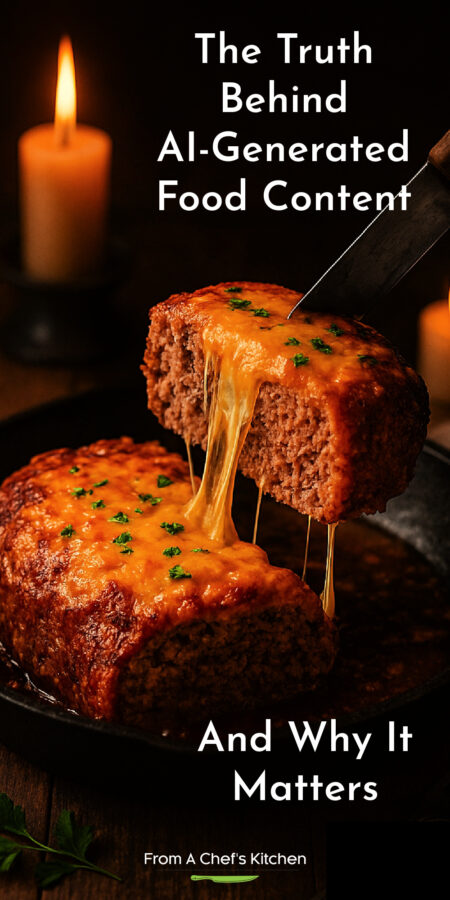
Have you ever encountered a recipe on Pinterest or Facebook that looks mouthwatering in photos but feels off when you try to make it? An AI-generated recipe created by a fraudster may have pulled a fast one on you and you fell victim to AI slop. What’s at stake isn’t just flavor, it’s your time and money. Here’s what you need to know about AI-generated content and how to spot the difference before you waste time and ingredients.
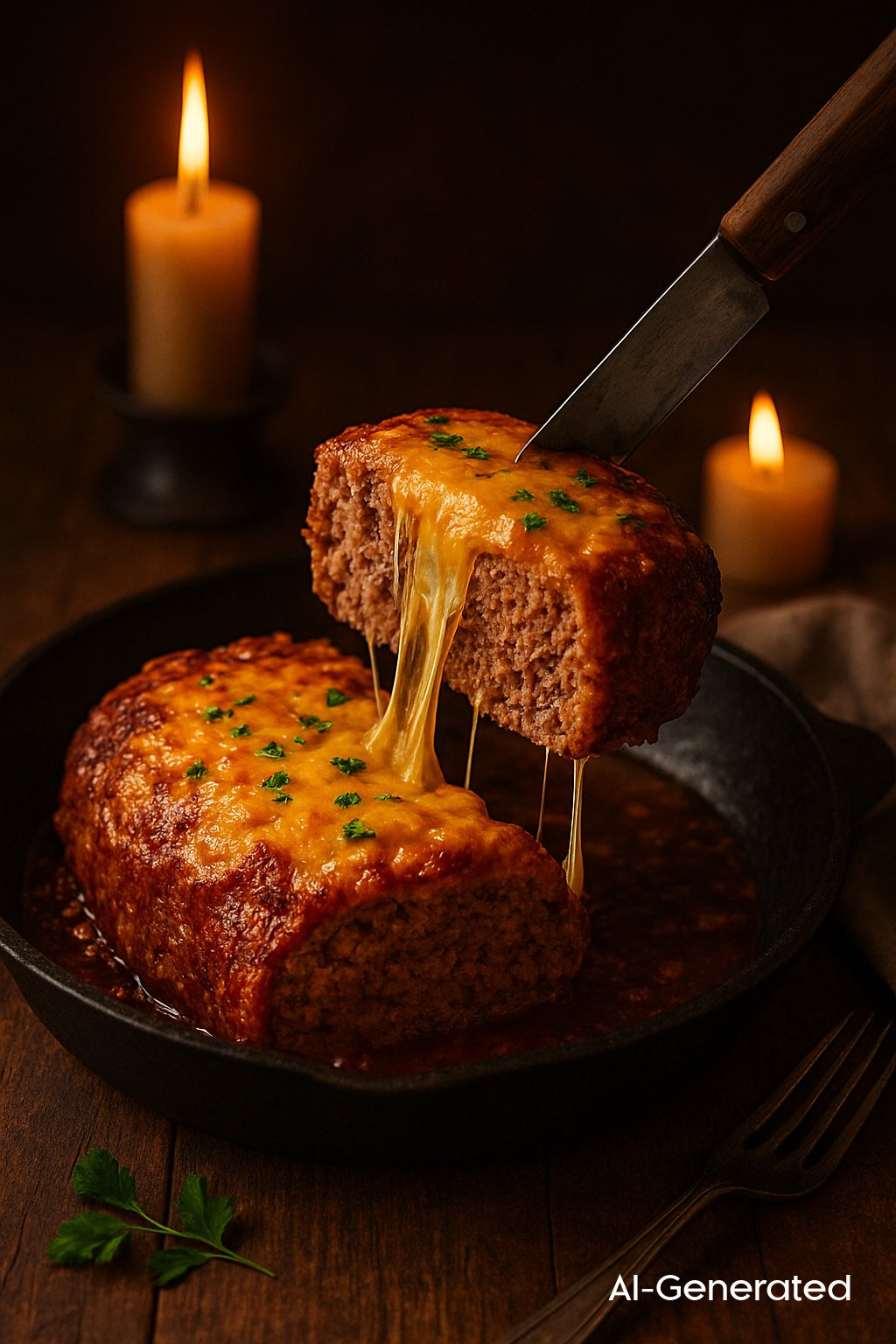
Table of Contents
- First, WHAT IS AI?
- how ai “develops” a recipe
- A QUESTION FROM A FRIEND
- THE ANSWER:
- HOW FRAUDSTERS CREATE THE IMAGES:
- HOW TO determine AN AI-GENERATED FOOD PHOTO:
- more examples of AI-generated food photos:
- Google lens – a free tool everyone can use
- how to know you’re on a fake “food blogger” website
- FAKE AI CONTENT ON PINTEREST
- fake ai content on facebook
- ai on ETSY
- MORE RESOURCES
First, WHAT IS AI?
Here’s the answer as generated by AI (Chat GPT):
“Artificial intelligence is when computers are designed to think and learn in ways that mimic human intelligence. Instead of just following fixed instructions, AI can recognize patterns, make decisions, solve problems, and even improve over time as it processes more information.”
In the last two years, AI has exploded. Free online programs such as ChatGPT, Grok, Claude, and Gemini are fast becoming the norm for everything from answering questions to writing sympathy cards, researching, and even cooking advice and recipes. Parents, your children could be using it for their schoolwork.
When used ethically and responsibly, these applications hold incredible possibilities for the future. However, they’re also being used by bad actors who care nothing about you. They create photos, recipes, and full websites either completely AI-generated or by stealing the work of hardworking food bloggers and altering it with AI.
Unfortunately, unscrupulous ad networks that are just out to make a buck have monetized these sites, which only fuels the fraud.
Thankfully, AI-generated content and photography can not currently be copyrighted, even though many of the slop sites say “Copyright.”
how ai “develops” a recipe
I asked ChatGPT where a recipe comes from if I were to ask it for one. Here is the response:
“When you ask me for a recipe, I don’t go pull one directly from a specific cookbook, website, or database. Instead, I generate a recipe based on what I’ve learned from patterns in a huge mix of text sources I was trained on (like publicly available cookbooks, food writing, and general recipe structures). That means I’m creating a recipe for you in real time, rather than retrieving or copying one from somewhere else.”
That’s all well and good that AI is not directly “copying” a recipe from somewhere else, like many slop farmers do. However, it isn’t testing the recipe either.
AI has also been known to spit out recipes with dangerous ingredients or combinations that make no sense. Bratwurst ice cream, anyone? (UK Guardian)
A QUESTION FROM A FRIEND
After commenting on numerous Facebook posts shared by friends alerting them to the fact that they were sharing an AI-generated photo and recipe, directing them to various videos that people have been doing to alert their followers about this issue, online articles, an HBO John Oliver segment, and finally receiving an email from a friend inquiring about AI recipes, I decided to gather all the information here, so I can just direct them to this post.
And yes, by exposing them here, I can recoup some of the earnings I’ve lost by having my images and recipes stolen by the AI slop farmers.
The friend, who is a retired library teacher and taught students about copyright and fair use, had this question:
“Perhaps it is obvious, and I’m just unaware, but how do you tell if a recipe is AI-generated? I’m generally fairly tech savvy, but I have to admit I’m not sure what I’m looking for to recognize AI. Hard to keep up with tech!”
THE ANSWER:
The answer is complex.
The fakery is out of control and quite nefarious. It’s referred to as AI slop. Until laws governing AI usage are enacted and penalties imposed for theft and deception, it’s the Wild West on social media and the internet right now!
It’s not always easy to tell if a recipe was AI-generated, so by learning to spot the fake sites, Pinterest pins, Facebook pages, and groups, you’ll be better informed and can avoid being misled by low-quality, deceptive content.
HOW FRAUDSTERS CREATE THE IMAGES:
I asked ChatGPT to create a photo of a cheesy meatloaf. It took a few minutes to generate, but using the “GPT” for image creation, I got this photo:
It then provided a list of options to fine-tune the photo, and I could choose any of them because ChatGPT is forever helpful:
Style Variations
- 1. Extreme Cheese Pull 🧀
Focus on long, stretchy melted cheese pulling dramatically from the loaf. - 2. Steam Rising 🌫️
Capture the heat—visible steam rising from the freshly cut slice. - 3. Rustic Cast Iron Detail 🍳
Highlight the skillet, rustic utensils, and hearty textures. - 4. Hands in Frame ✋
A human hand holding the knife or fork mid-slice for realism. - 5. Overhead Action Shot 📸
Top-down perspective showing the slice being lifted away from the loaf. - 6. Plated Slice Moment 🍽️
Slice being transferred onto a rustic plate with garnish and sides.
I chose Option #1 and got the scary image at the top of this post. Yes, it’s that easy to create a “food photo” with AI.
This example may be extreme, but given the number of people sharing fake AI-generated food photos and recipes on social media, many people can’t tell the difference and either unknowingly or actively promote this deception.
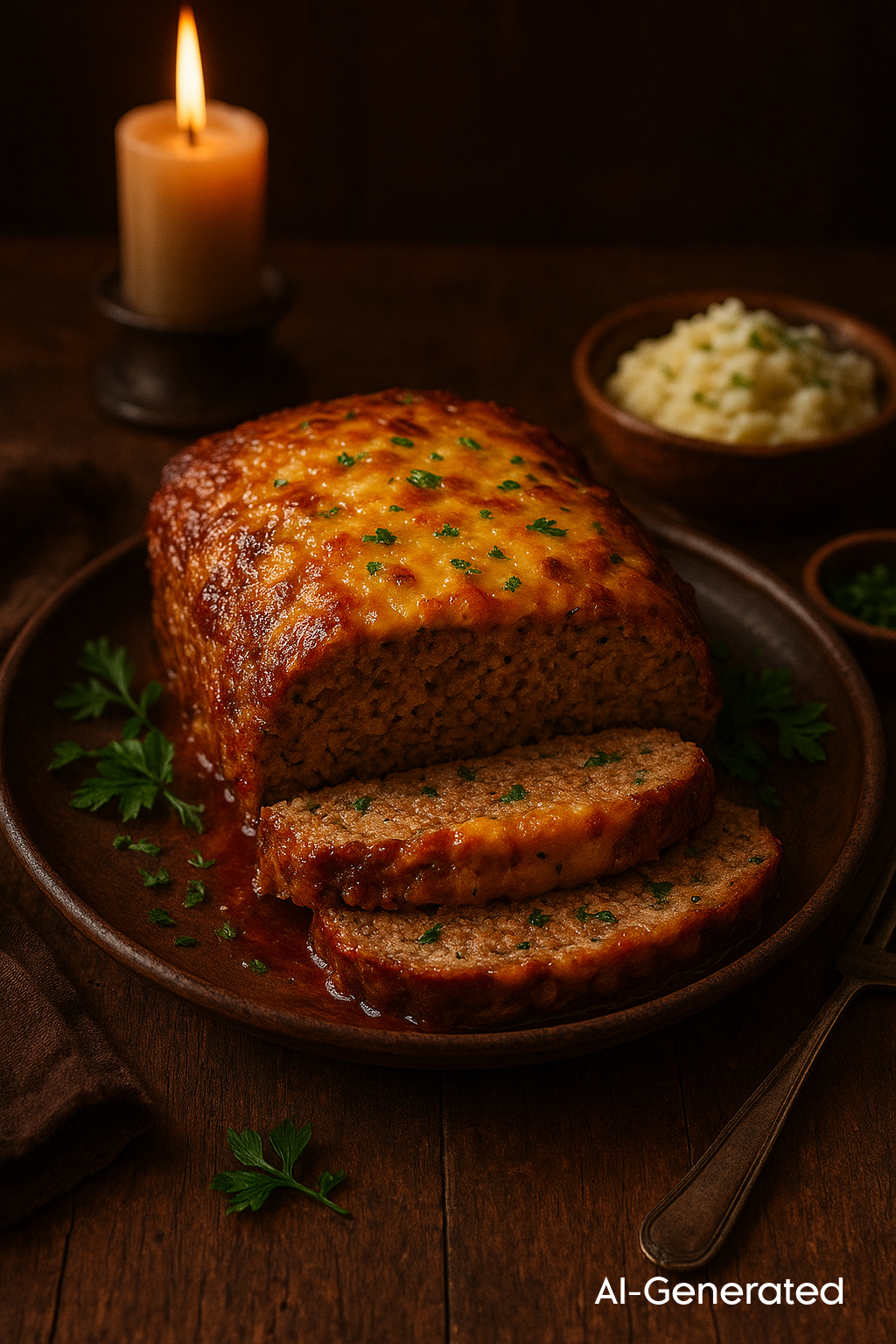
Here they are again.
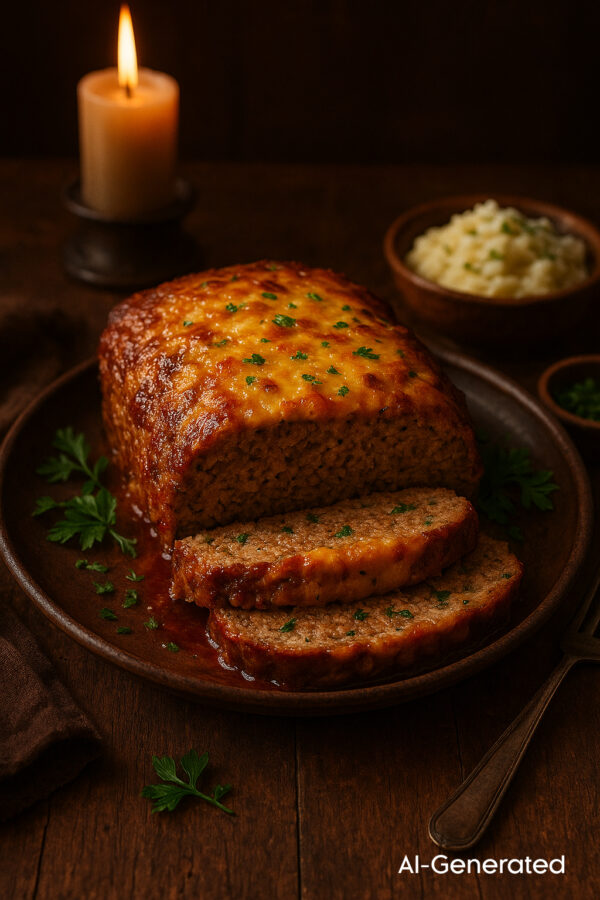
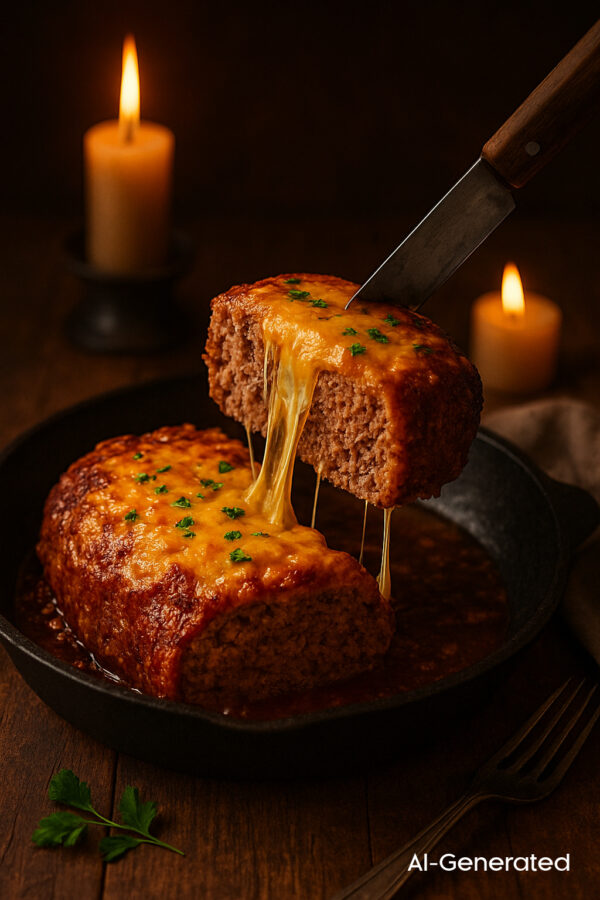
Human food photographers and food bloggers have invested thousands of dollars in camera and lighting equipment, editing programs, props, courses, and workshops to better themselves and learn their craft. AI-generated photos meant to deceive take all that away with the click of a keyboard.
Here are photos of REAL human-created, human-tested meatloaf recipes. Beautiful human imperfection!


HOW TO determine AN AI-GENERATED FOOD PHOTO:
Having done food photography for over 15 years, I can pick them out quickly. But that’s not always the case to the untrained eye. AI food photo creation is improving, making it increasingly challenging to differentiate real from artificial intelligence.
If you’ve ever paid attention to what that perfect swirl of mayonnaise that was machine-filled looks like when you first open the jar, it’s that same feel and look you’re getting in an AI-generated food photo.
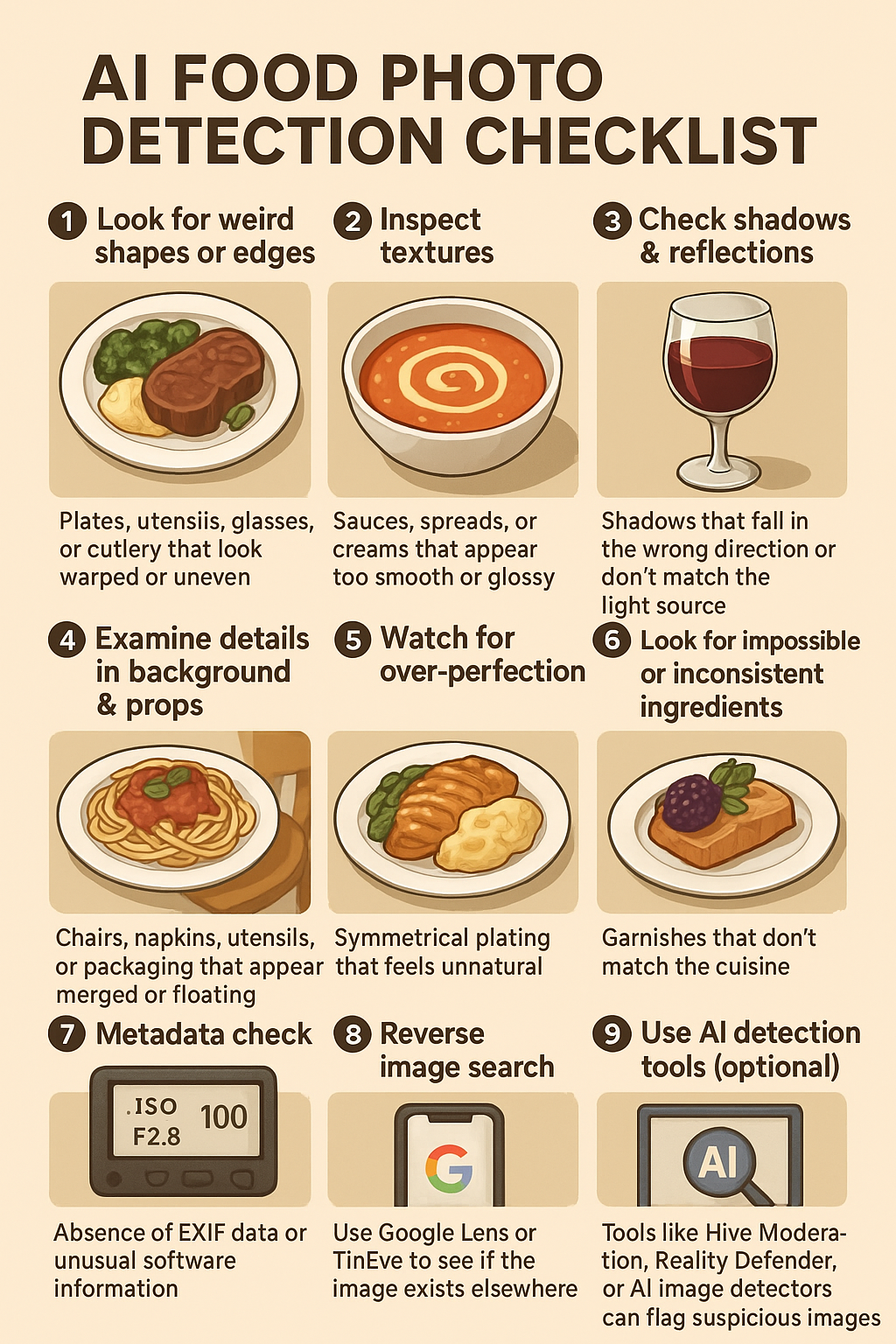
To boil it down, I asked ChatGPT how to distinguish an AI-generated photo from a real one. (There are exceptions to these.)
1. Look for weird shapes or edges
- Plates, utensils, glasses, or cutlery that look warped or uneven.
- Food items with inconsistent shapes or impossible stacking.
2. Inspect textures
- Sauces, spreads, or creams that appear too smooth or glossy.
- Meat, bread, or vegetables lacking natural imperfections.
3. Check shadows and reflections
- Shadows that fall in the wrong direction or don’t match the light source.
- Reflections in liquids, metal, or glass that look blurry, missing, or distorted.
4. Examine details in background and props
- Chairs, napkins, utensils, or packaging that appear merged or floating.
- Fingers, hands, or human elements that look twisted or extra-long.
5. Watch for over-perfection
- Symmetrical plating that feels unnatural.
- Colors that are too bright, uniform, or perfectly arranged.
6. Look for impossible or inconsistent ingredients
- Garnishes that don’t match the cuisine.
- Cooked textures that seem incorrect (e.g., raw and baked parts mixed).
7. Metadata check
- Has unusual software information.
- The absence of EXIF data (Exchangeable Image File format data), which is a standard format for storing metadata within image and audio files created by digital cameras.
8. Reverse image search
- Use Google Lens or TinEye to see if the image exists elsewhere.
- Lack of real-world references can be a red flag.
9. Use AI detection tools
- Tools like Hive Moderation, Reality Defender, or AI image detectors can flag suspicious images.
10. IF SOMETHING LOOKS OFF, IT PROBABLY IS:
ChatGPT was even nice enough to create a neat little graphic for this information:
more examples of AI-generated food photos:
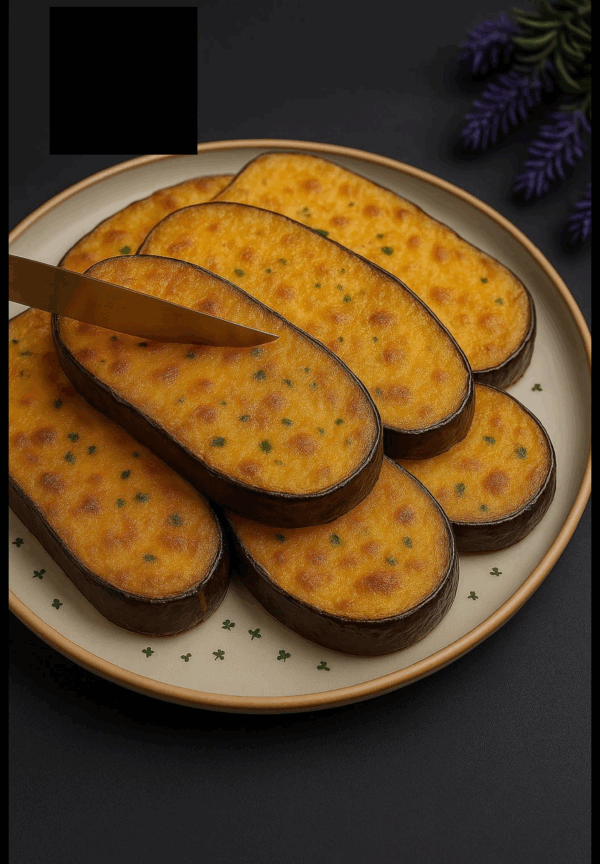
These were shared on Facebook with thousands of likes. Notice anything off? Have you ever grown square zucchini, cut an avocado like that, seen oval eggplant or sprinkled a plate with tiny three-leaf clovers?
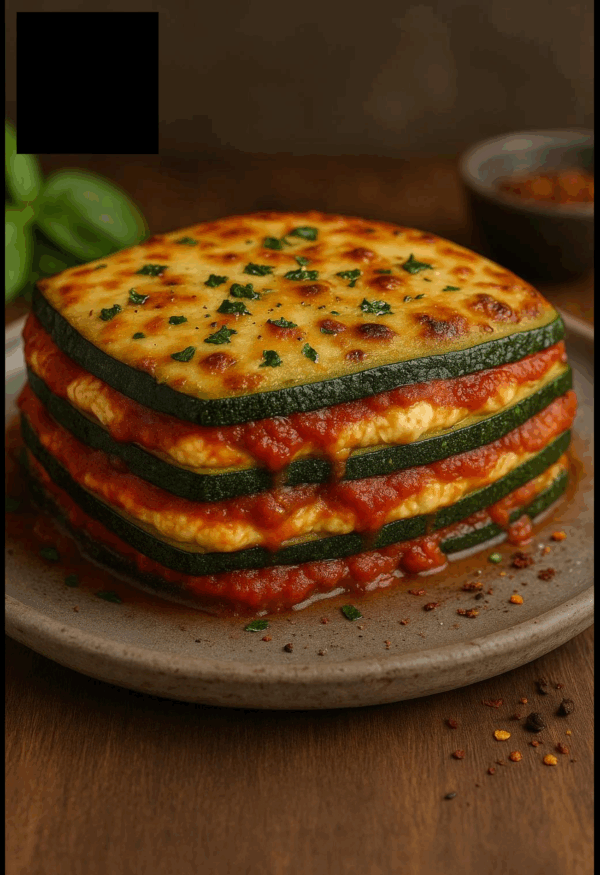
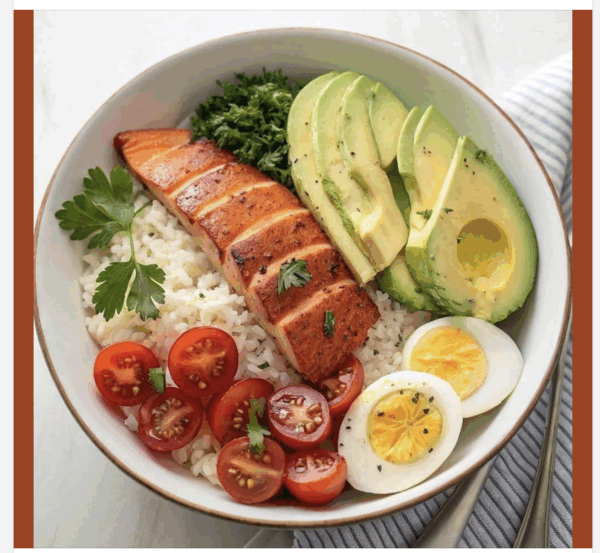
However, AI-generated photos are not always that easy to distinguish. Here are a few more examples that could easily pass for the real thing. Because these photos look so real, they could be a stolen photo which the fraudster ran through an AI program such as Midjourney.
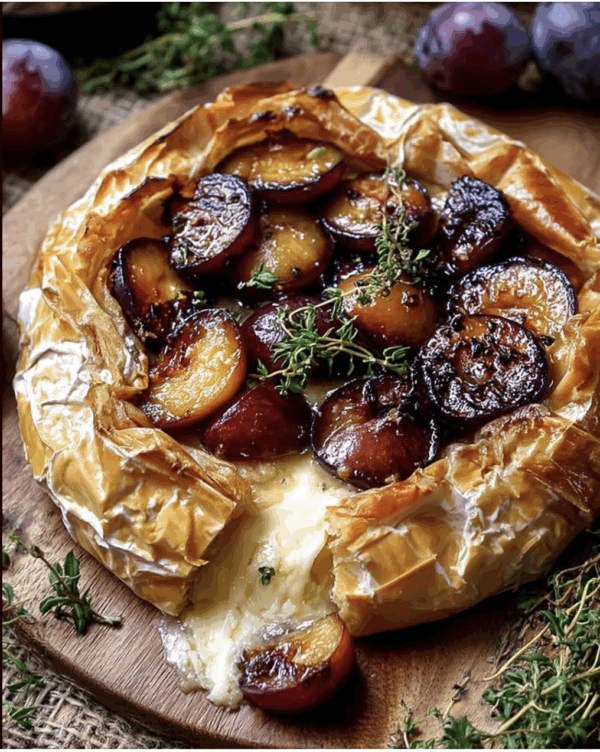
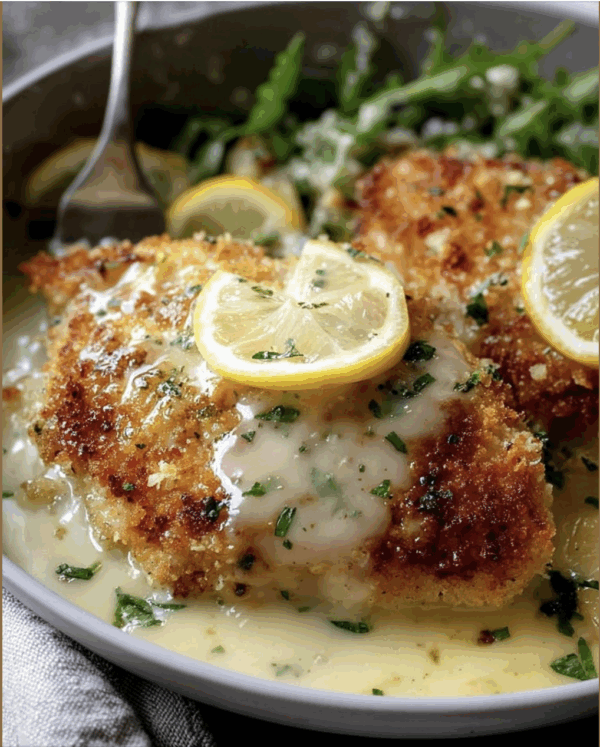
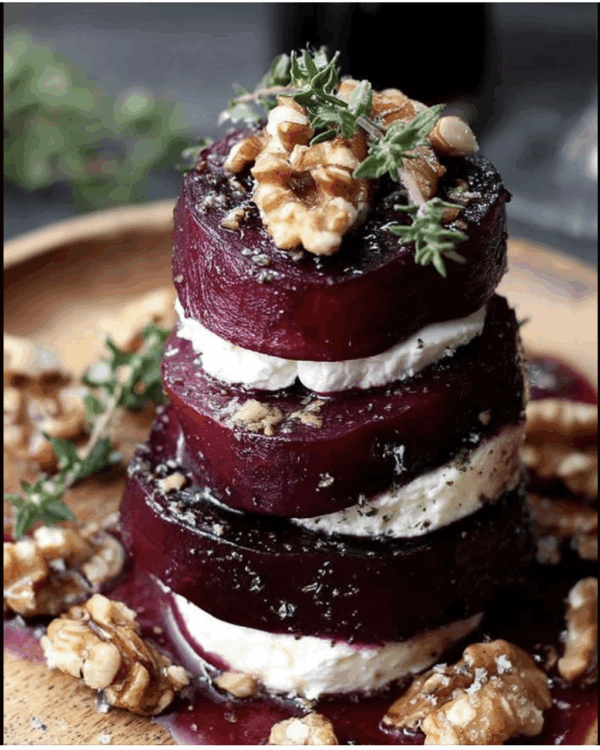
Often, an attempt is made to make everything look extra buttery, cheesy, saucy, and gooey because people respond to this.
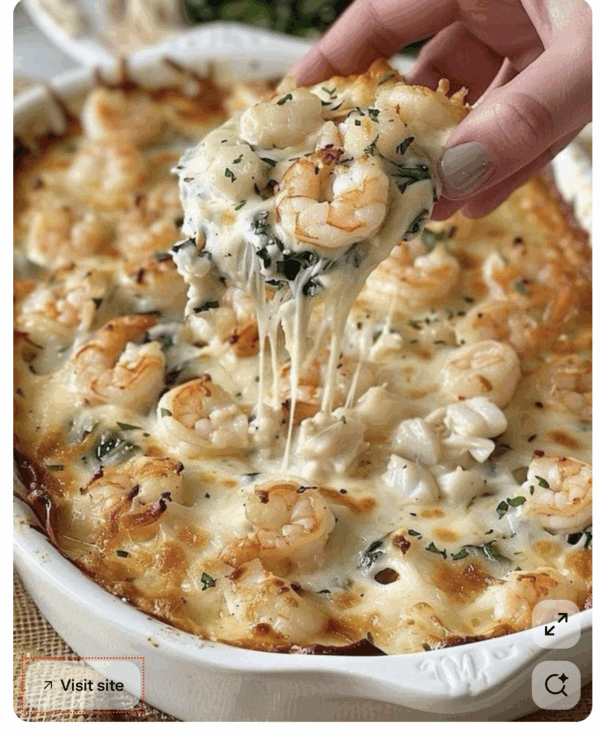
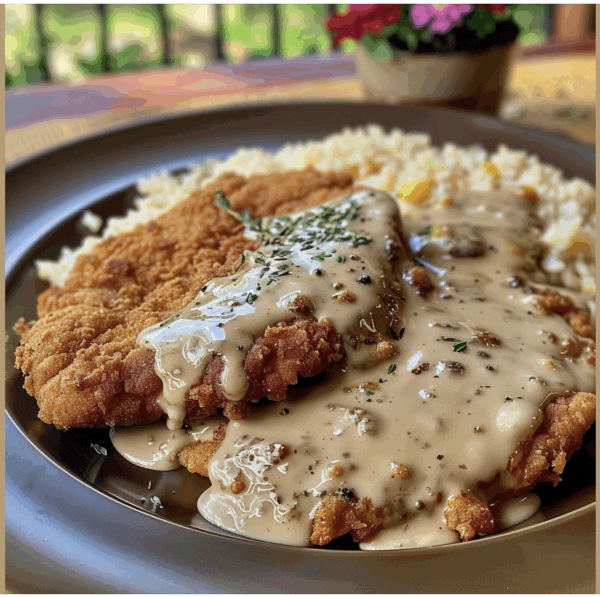
And, if something looks “off,” it probably is:
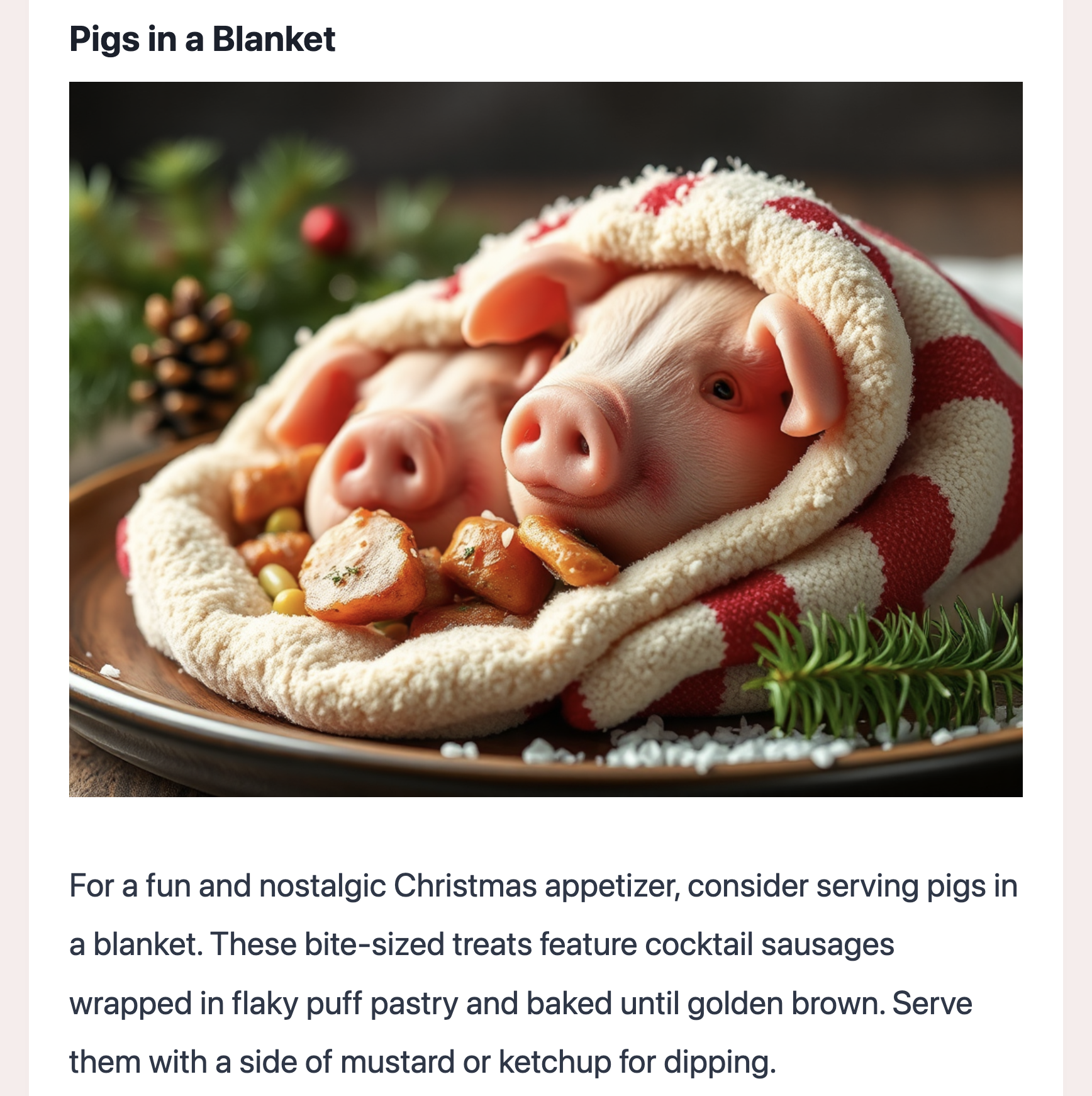
Google lens – a free tool everyone can use
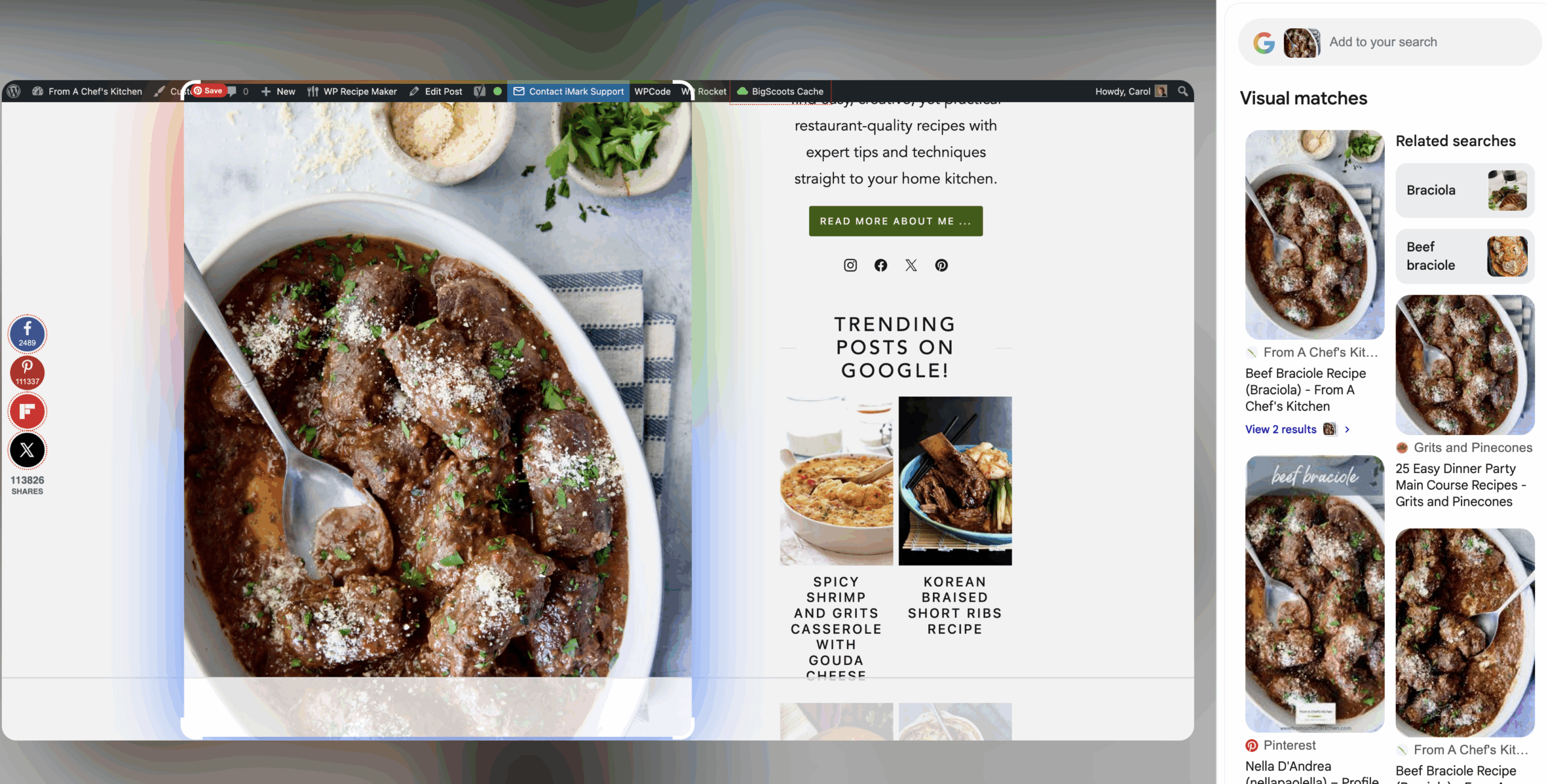
If you’re unsure whether it’s real or AI, right-click on the photo, select “Search with Google Lens.” There are a lot of variables, but Google Lens will often reveal its origin. It also works on Facebook.
Here’s one of my top recipes that I had Google Lens inspect: Beef Braciole
Note all the visual matches on the right because it’s a human-created copyrighted photo.
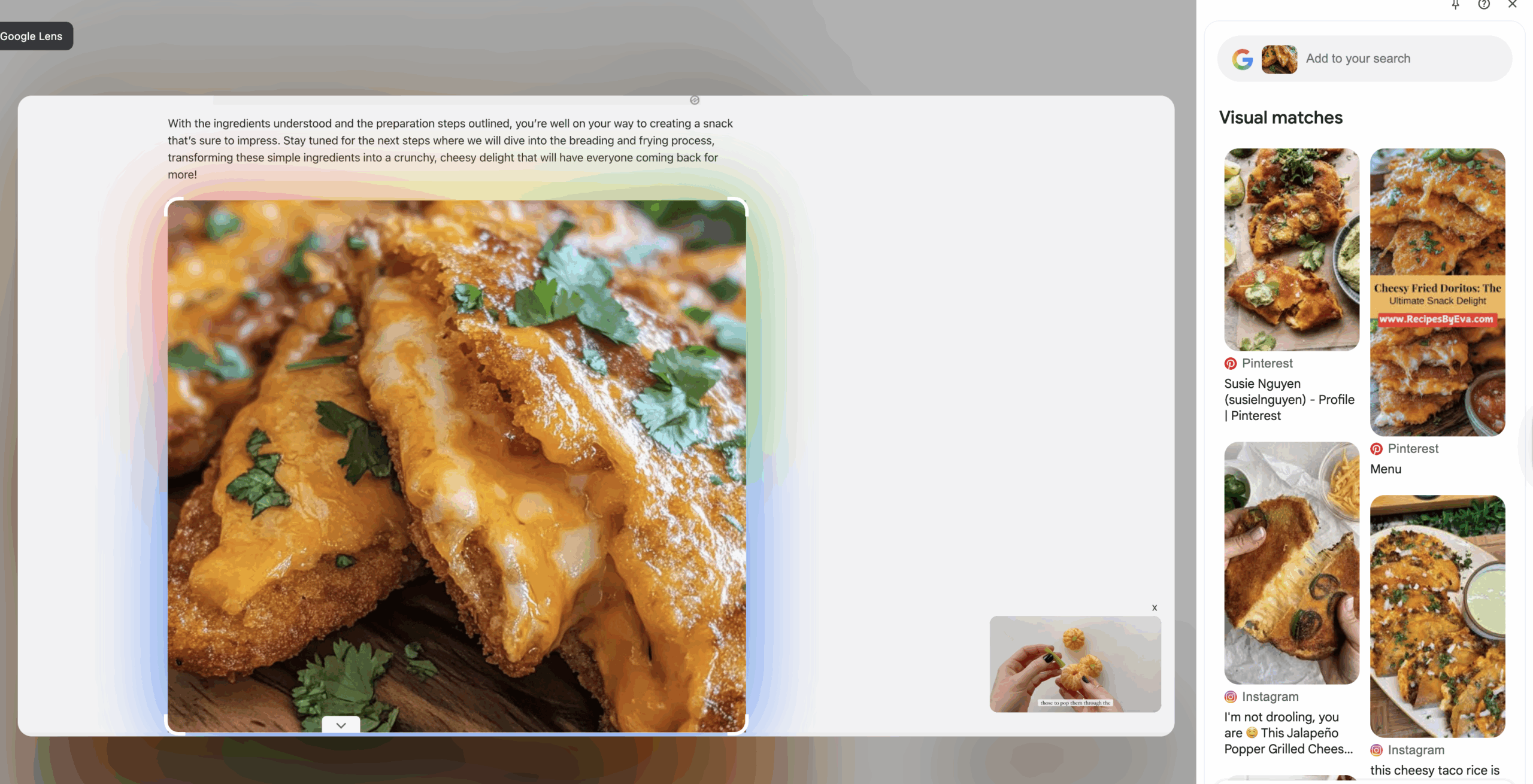
This AI slop recipe for “Crunchy Fried Cheese Stuffed Doritos” has no visual matches on Google Lens except for an AI-generated pin on Pinterest. When visual matches do come up, they often take you to the Facebook groups and pages of the AI slop farmer. (See the Facebook section below.)
By the way, I love stuffed Doritos, don’t you?
how to know you’re on a fake “food blogger” website
SUSPICIOUS website nameS:
The names of some of these fake AI “food blogger” sites are just as bizarre as the photos and the recipes. Real food bloggers put a lot of time, effort, emotion and thought into their blog names, branding, and URLs because it’s personal to them and they’re invested in it. When real food bloggers share recipes, they’re sharing a piece of themselves–they are passionate about their craft.
With an AI slop site, the name of the site doesn’t often make sense. A quick scan of Pinterest revealed these gems:
- Foodiffy
- Forkfulheaven
- Foodmadegently
- Crisptastes
- Myauntyrecipes
- Cookcraze
- Cookedbymomy
- Pamdishes
- Tasteofrecipe
- Dishestasty
the site is extremely slow to load:
- The site is extremely slow because shoddy, spammy ad networks are the only way these sites can monetize. The best ad networks use the latest technology to allow their member sites to load quickly.
- Reputable ad networks like Raptive will not monetize these sites. Look for “A Raptive Partner Site” at the very bottom of a website (like mine), and you’ll be assured that there’s a real human creator behind the site.
- Mediavine, another reputable ad network many food bloggers use, is working to clean out AI sites and has stepped up its effort to support human creators.
- Another reason the site could be slow to load is that they’re using a free WordPress theme. Most real food bloggers invest substantially in quality WordPress themes or custom website design so their sites load quickly, and are as user-friendly as they can make them.
they publish 20 recipes a day:
- Because they use AI, they can create recipes and photos instantly. No real food blogger can generate content that fast because we often test, write, and photograph ourselves. Everything from doing the grocery shopping, recipe development, testing, photographing, and writing is done by a human creator and that all takes time.
they impersonate people:
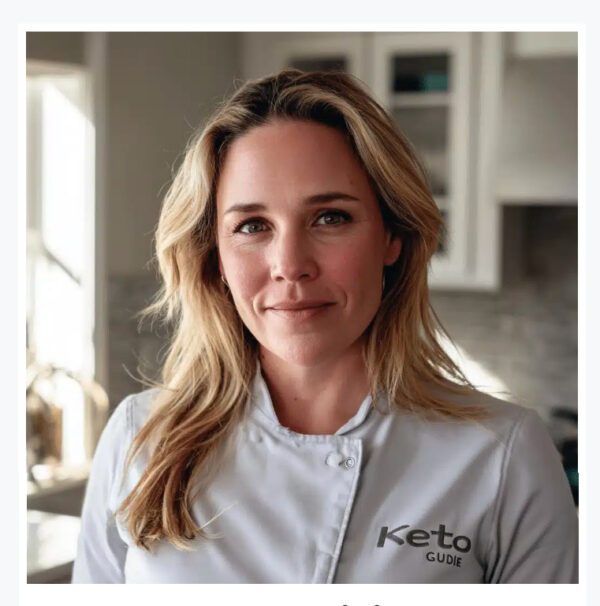
- Some use people’s real names, making it even more insidious because AI is now impersonating a human being. These three “people” are not real but use sweet, lovely names like Olivia, Grandma Betty, and Tyla to gain your trust.
- Notice the same “feel” with the blurry backgrounds. It’s another sign the photos are AI-generated. But don’t they all look so sweet and friendly?

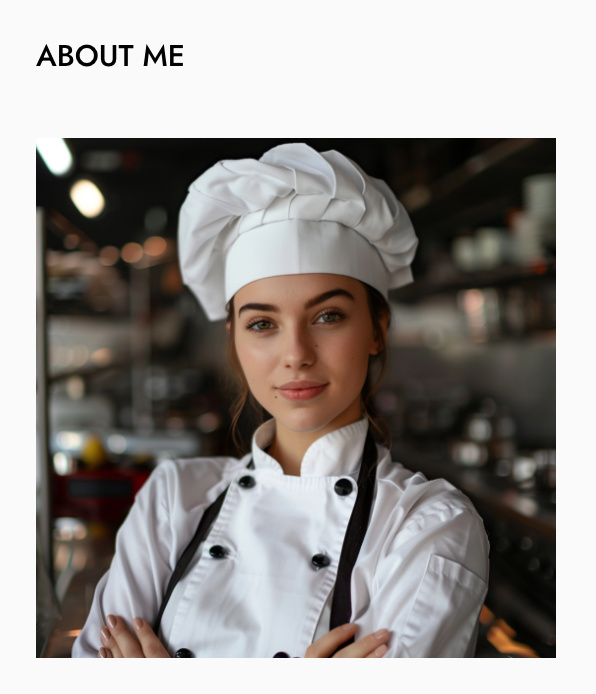
- Another tactic is that there’s no actual photo of the person anywhere on the site. Real food bloggers always have their photo on their site because they ARE REAL.
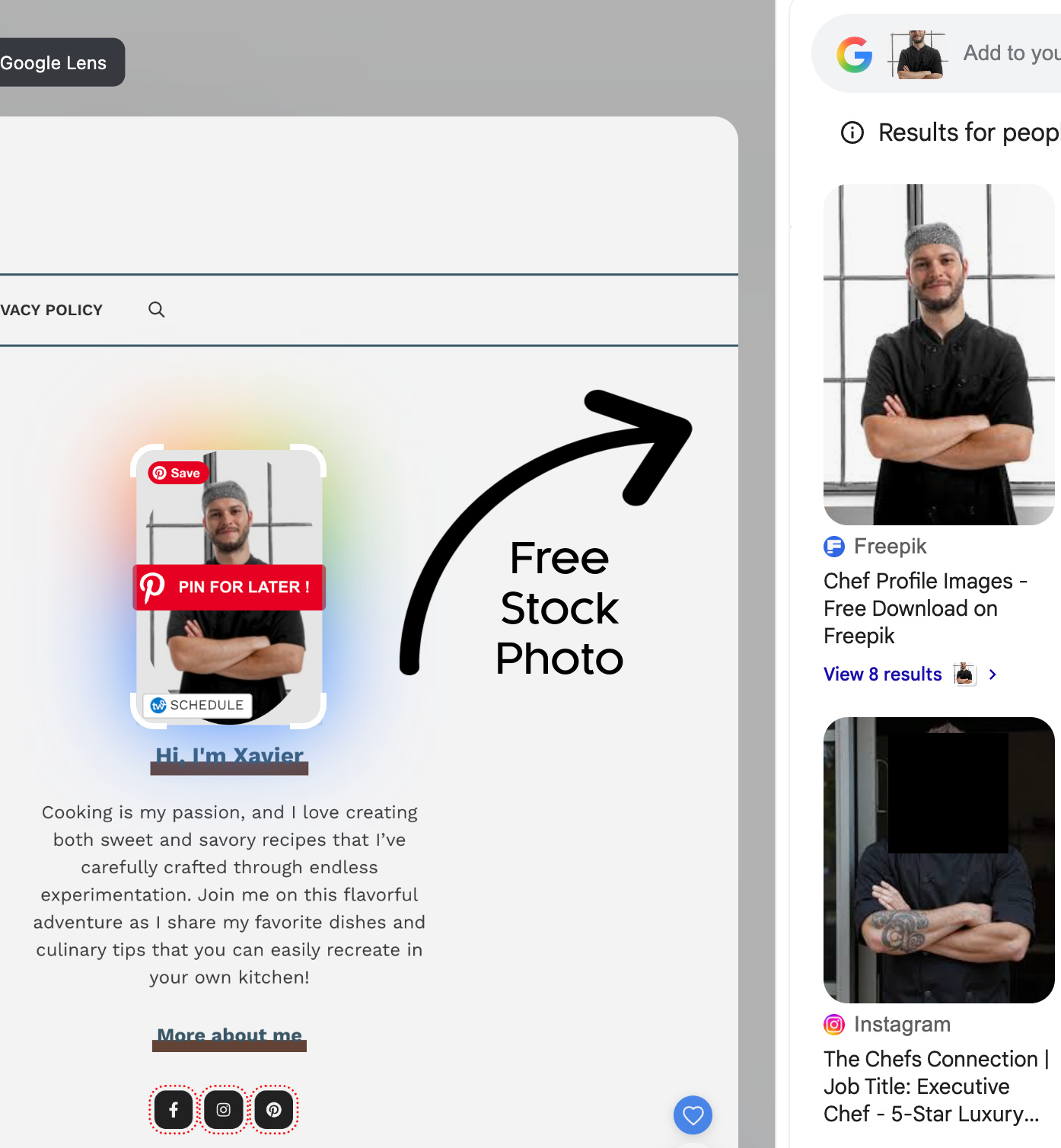
- They’re using a stock photo of someone. Ol’ “Xavier” here is a stock photo from Freepik as revealed by Google Lens.
FAKE AI CONTENT ON PINTEREST
Did you know that at least 75% of the content on Pinterest is AI-generated slop? That and the ads leave very little room for an authentic creator.
A YouTube channel I will not link to that has thousands of followers and is raking in a lot of money teaches scammers how to flood Pinterest with AI garbage. The people behind this scheme don’t care who gets hurt; frankly, they’re laughing at the people eating it up.
This article explains how AI slop farmers are specifically targeting older women. Futurism: Slop Farmer Boasts About How He Uses AI to Flood Social Media to Trick Older Women
what to look for on pinterest
- If a pin makes you pause and think, “something feels off,” it’s probably AI.
- Use the checklist/graphic above to distinguish AI pins and recipes from real food bloggers’ pins and recipes.
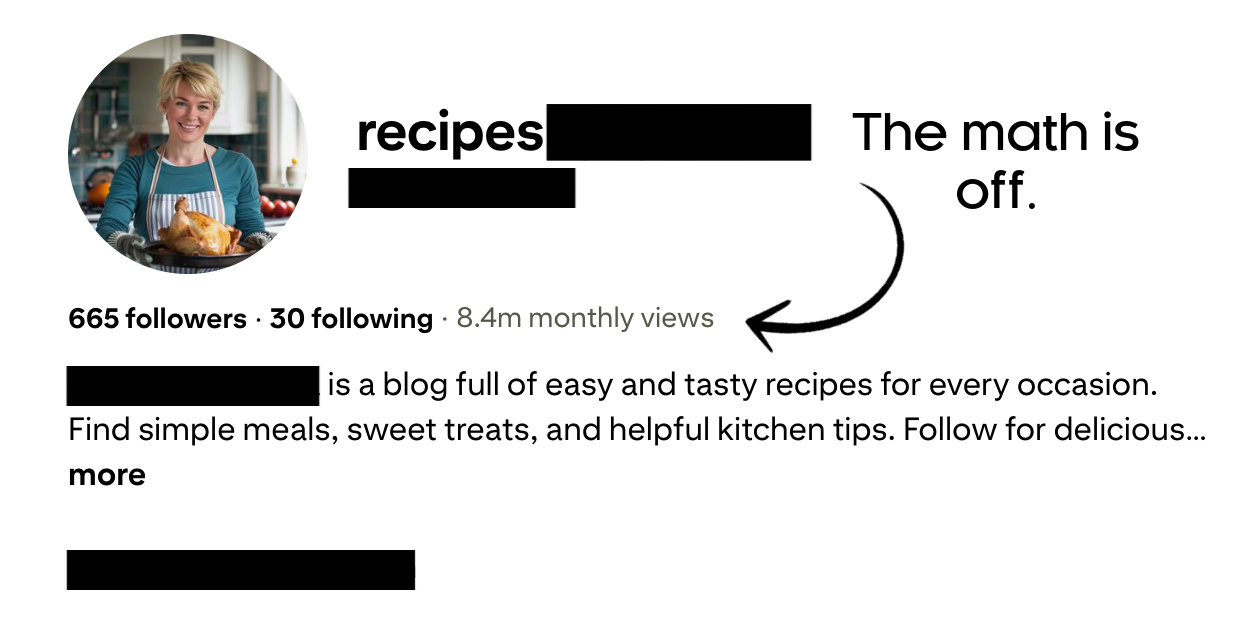
- Look at their Pinterest profile. Because they’re spamming Pinterest with pins, they have a high number of impressions, the number after the follower and following count, which are low in comparison to the number of impressions. A real food blogger would love these kinds of numbers. Real food bloggers don’t spam Pinterest with pins because they don’t want their accounts shut down; they’ve invested way too much time and resources developing their following and curating content. The fraudsters will just start a new account.
- Oh, look! The same photo is used on Facebook in the example below, but the scammer is using a different name.
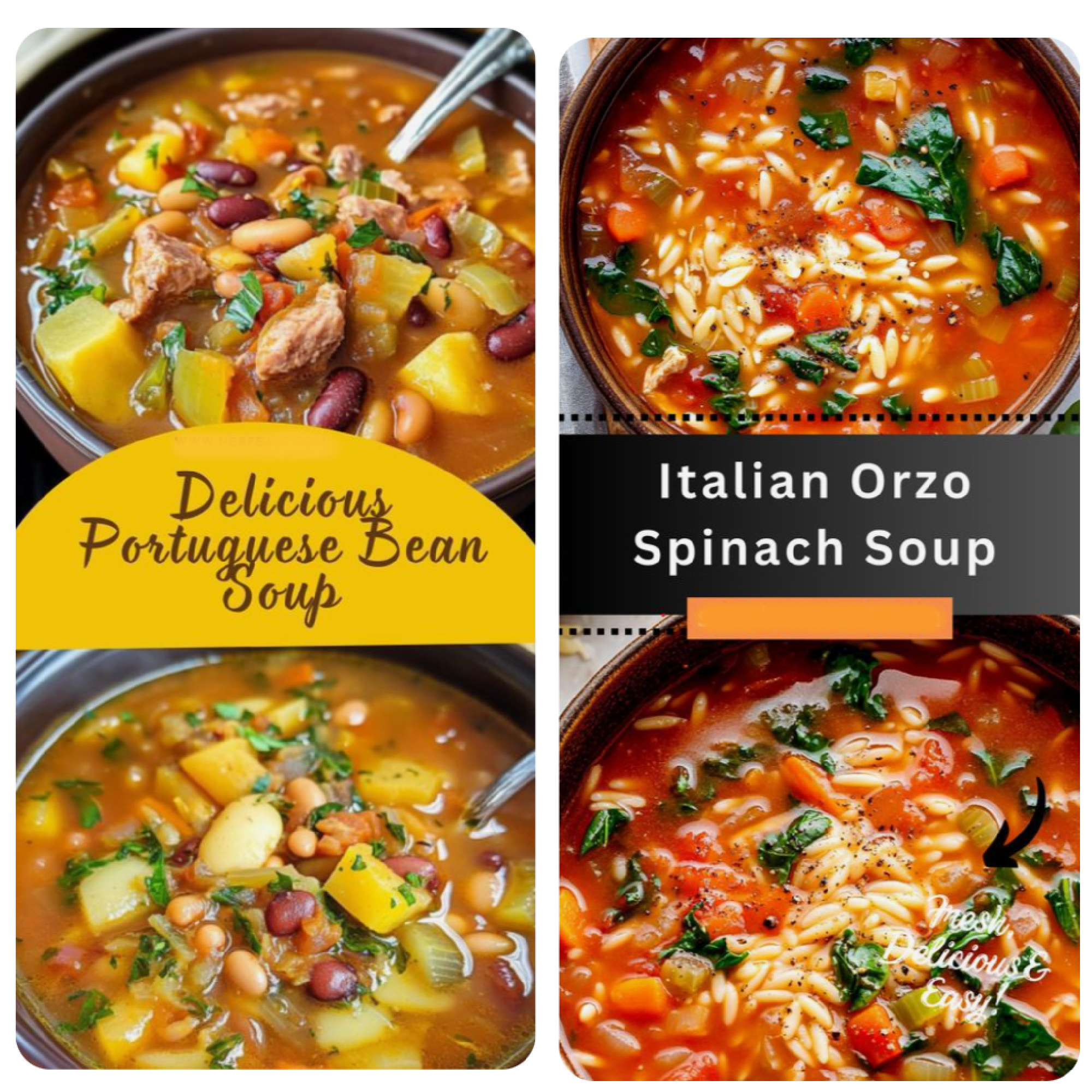
- A popular “format” for these AI pins has stacked images that look very similar. These taller pins often get more attention and engagement.
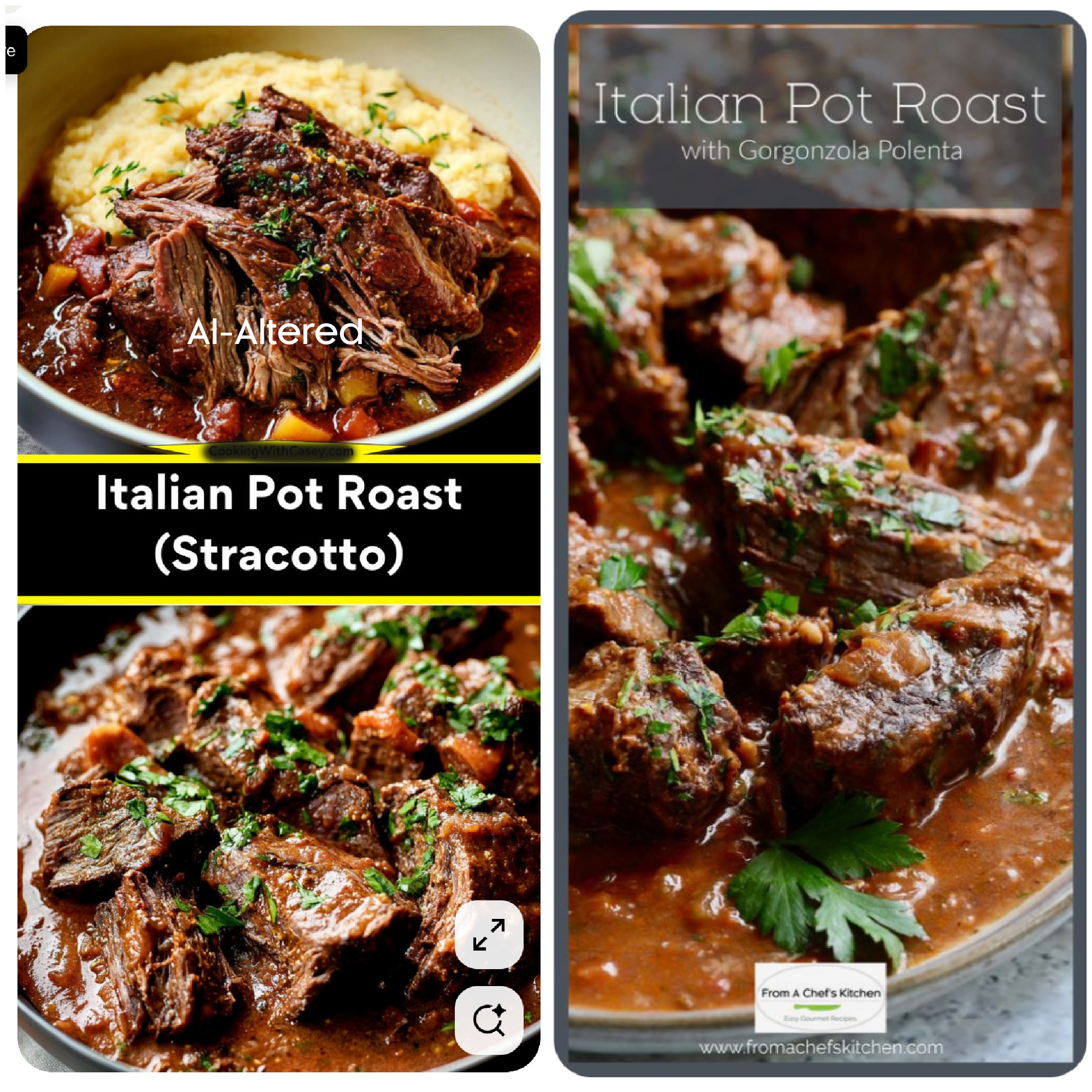
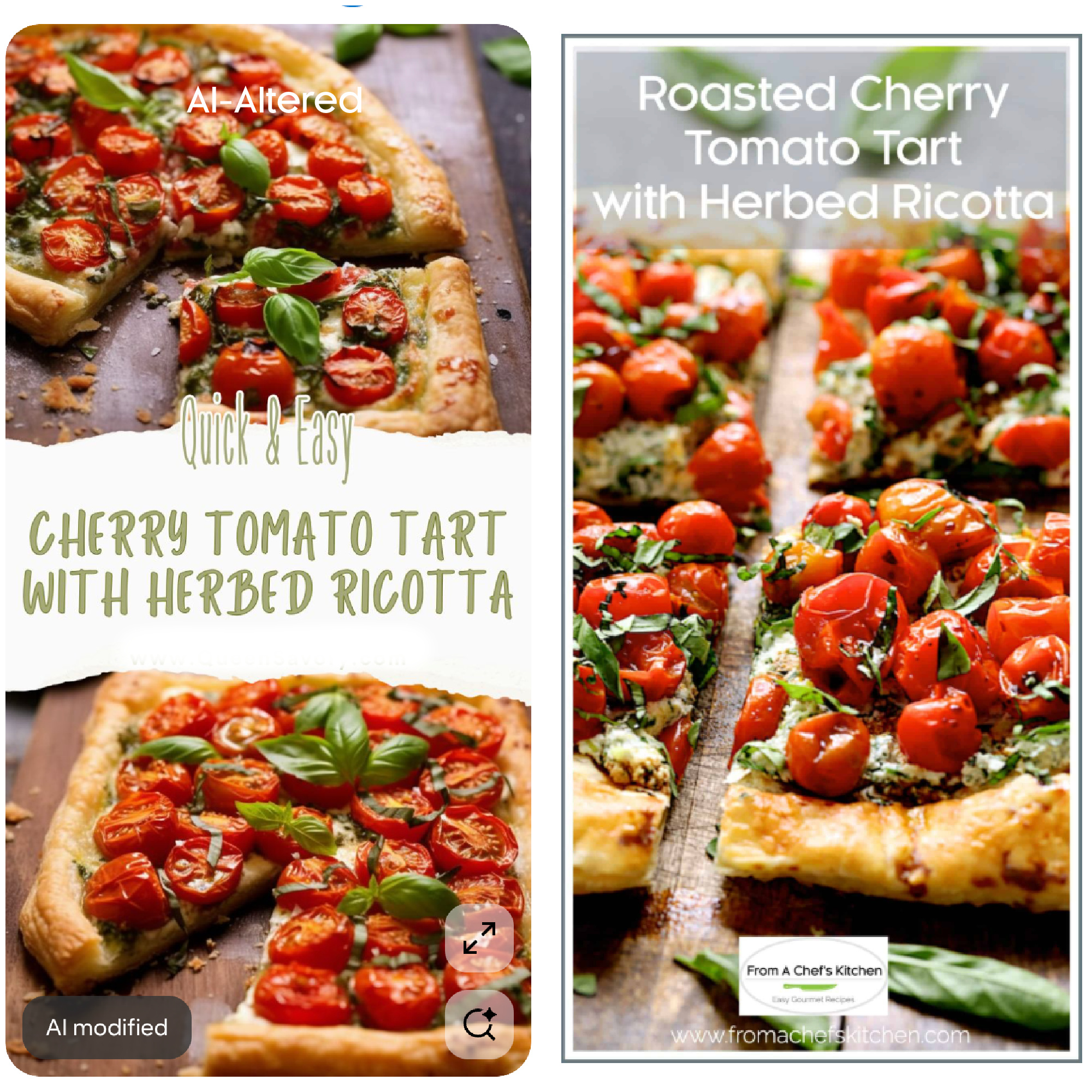
- Unfortunately, the AI-slop farmers are also stealing real bloggers’ work, running them through AI programs to alter them to get around copyright laws, and publishing as their own. This practice is called an image2image attack. Here are two examples of mine that have been stolen and altered with AI: My Italian Pot Roast and my Cherry Tomato Tart recipes. AI on the left, mine on the right.
Here’s the other photo on the pin the AI fraudster stole and altered:

And another…
fake ai content on facebook
Facebook has become an absolute cesspool of AI-generated food, recipes, fake groups, and fake pages. The more these get shared by your well-meaning friends, the more the algorithm perpetuates the scam.
There was a time when a blue checkmark meant something. It no longer does, because Facebook is granting blue checkmarks to fraudsters.
what to look for on facebook:
- Use the checklist/graphic above to distinguish AI photos.
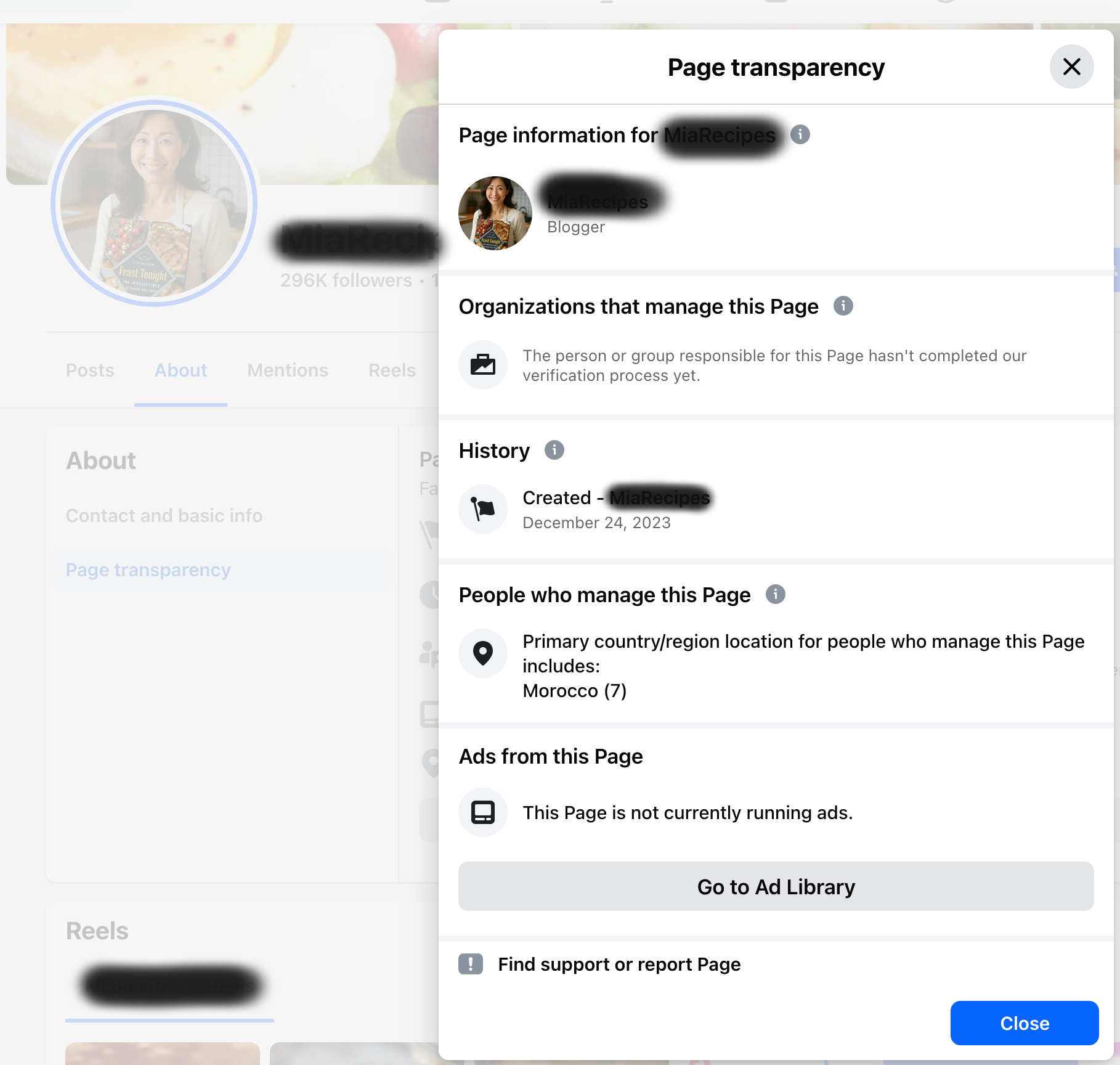
- Click the name of the Facebook page sharing the photo, go to “About,” and click on the “Page Transparency” section. This Facebook page, with a photo of a lovely woman holding up “her” AI cookbook (for sale on Amazon if you want an AI-generated cookbook) and 296,000 followers, also originated in Morocco. If there is a website link on the Facebook page, look for the ad network on the site. With 296,000 followers and that much traffic, “she” would be in a higher-quality ad network like Raptive, except Raptive doesn’t monetize AI slop.
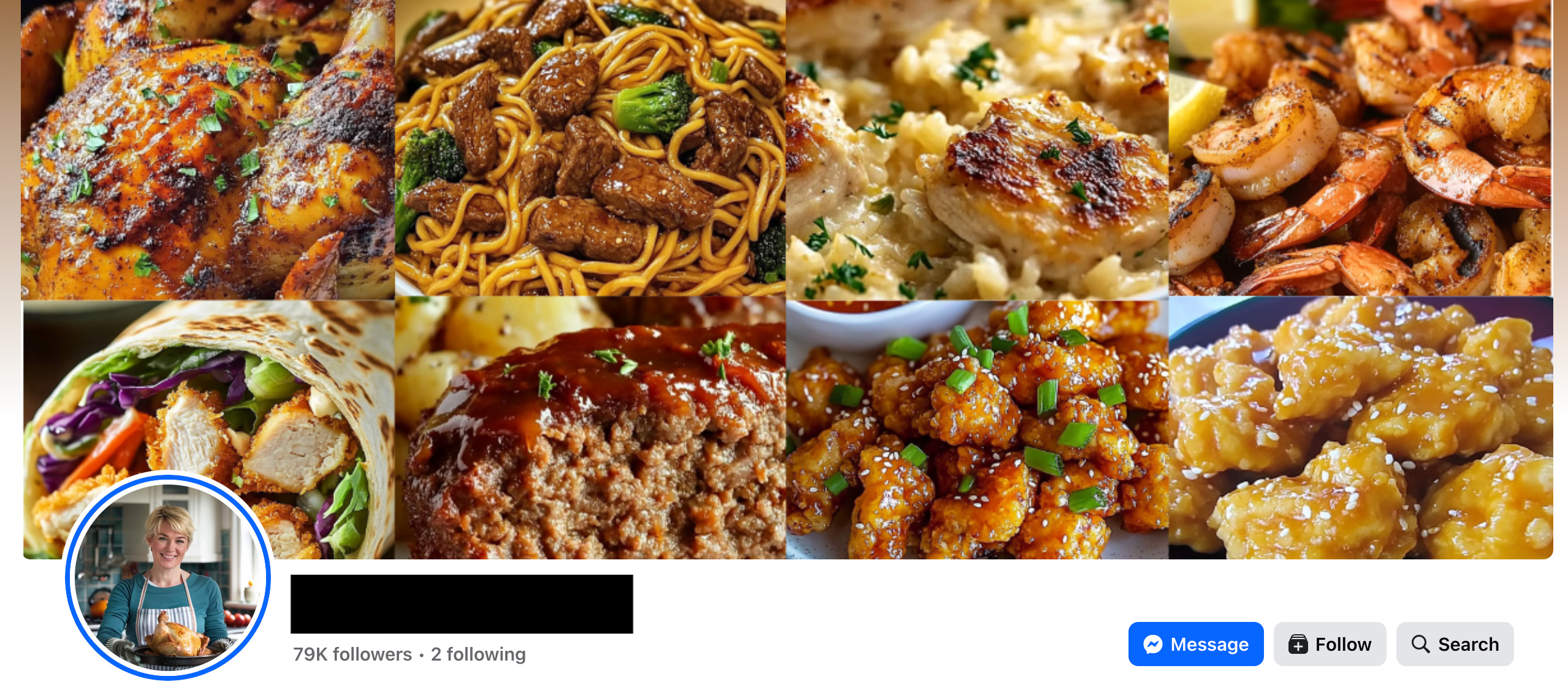
- This page has 79,000 followers with a profile photo of a lovely woman in an apron who wants to share her home cooking. Except that someone in Algiers created the page. The same AI-generated profile photo is being used on Pinterest in the example I showed above but is using a different name.
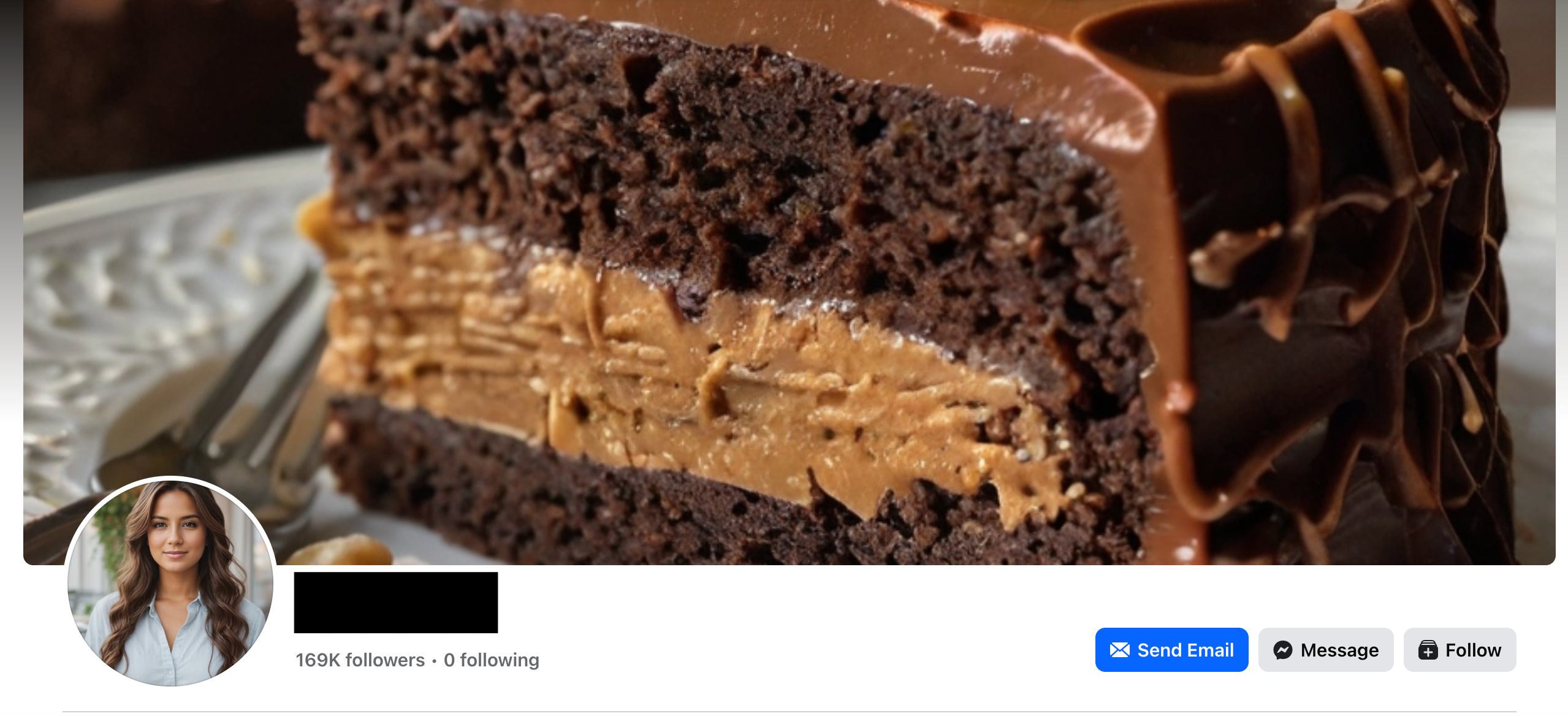
- Then there’s this popular page with 169,000 followers. The “Page Transparency” shows that the page originated in Morocco and Turkey.
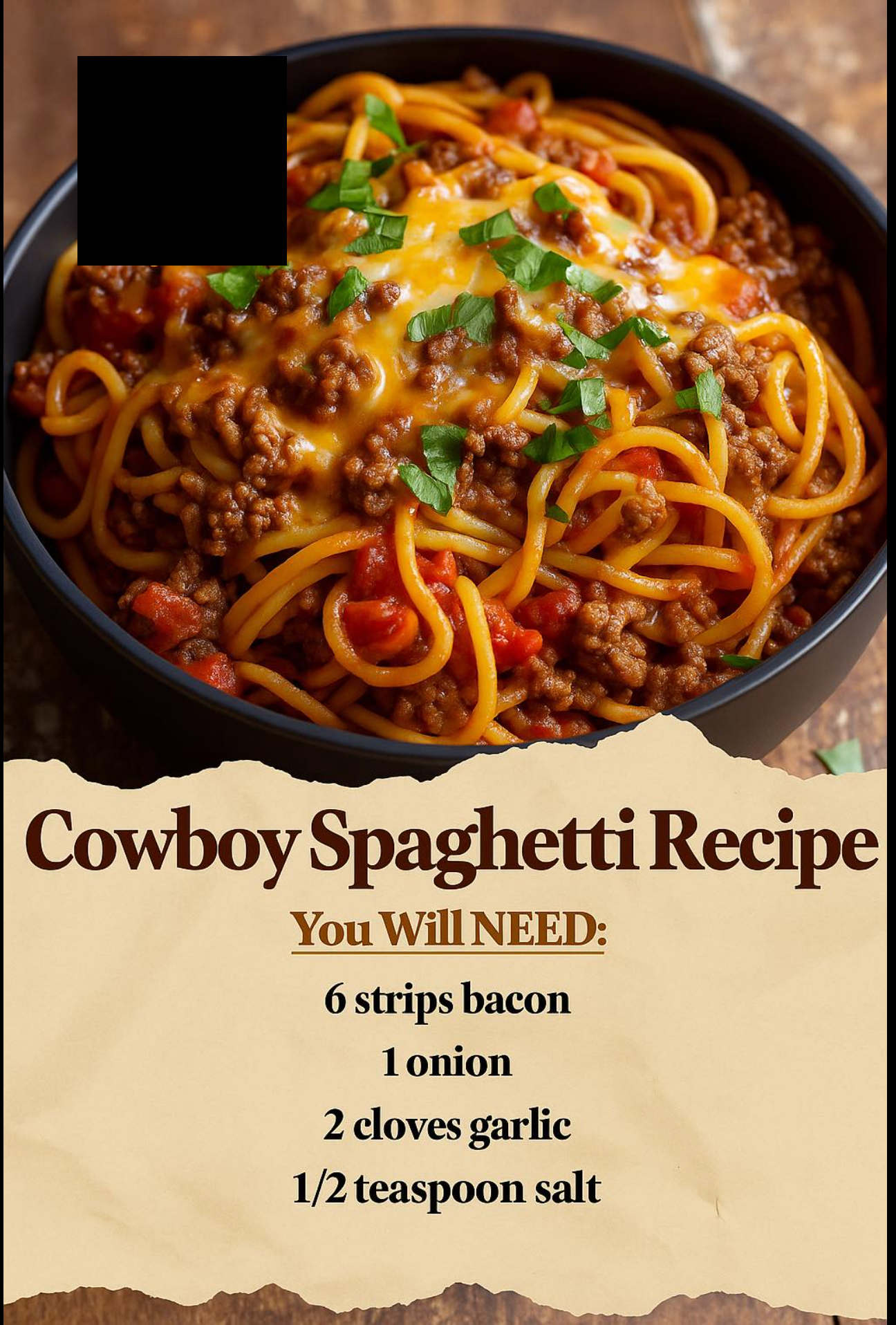
- If they provide the whole recipe in a post, it’s probably AI-generated or copied from a real food blogger. Facebook pays bonuses to creators (real and fake) when posts get shared a lot, and people LOVE getting the whole recipe without having to click on a site, so they share away.
- Any legitimate website like Taste of Home, Food and Wine, New York Times or mine along with thousands of real bloggers will never post the whole recipe on Facebook; there’s always a link to click back to the site because that’s our bread and butter. And yes, a fraudster in Morocco, Turkey or Algiers is getting paid because of Facebook user gullibility.
- A few ingredients are listed on an overlay that looks like a ripped piece of paper. Like the stacked pin format above, this format for Facebook has been popular with the sloppers.
- Finally, will the real Stanley Tucci, Ina Garten, and Ree Drummond please stand up? It has always been common for people to start Facebook groups in honor of their favorite celebrity chefs so they can cook and share their recipes. The AI sloppers have caught onto it and are using it to their advantage. Check the “People” tab in the group to see where all the “moderators” and “admins” are from. Chances are… Morocco.
ai on ETSY
This is a relatively new scheme by AI sloppers. When you click on a pin on Pinterest, sometimes you’re taken to Etsy, a popular site where you can purchase legitimate artists’ work. Source: Etsy.com
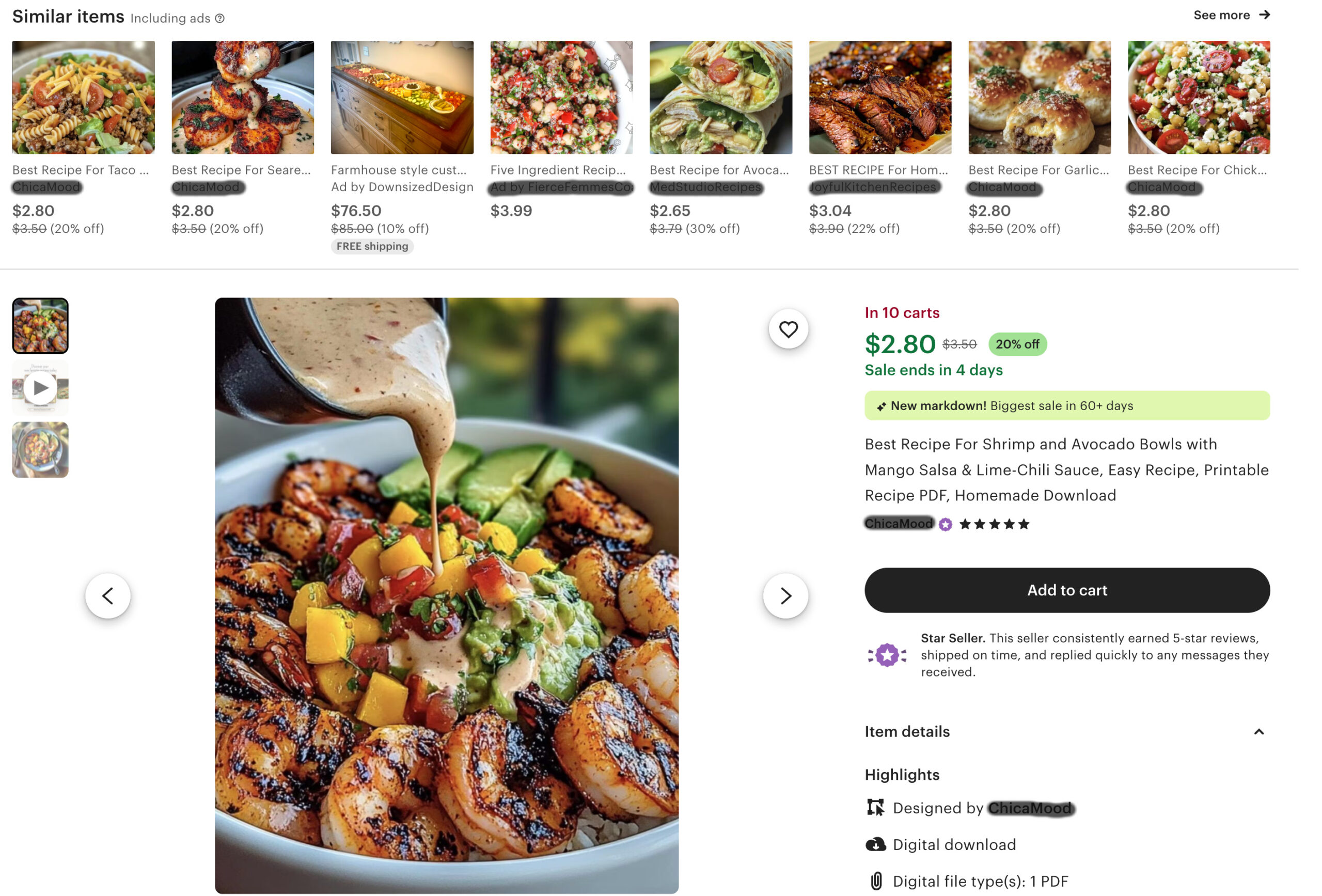
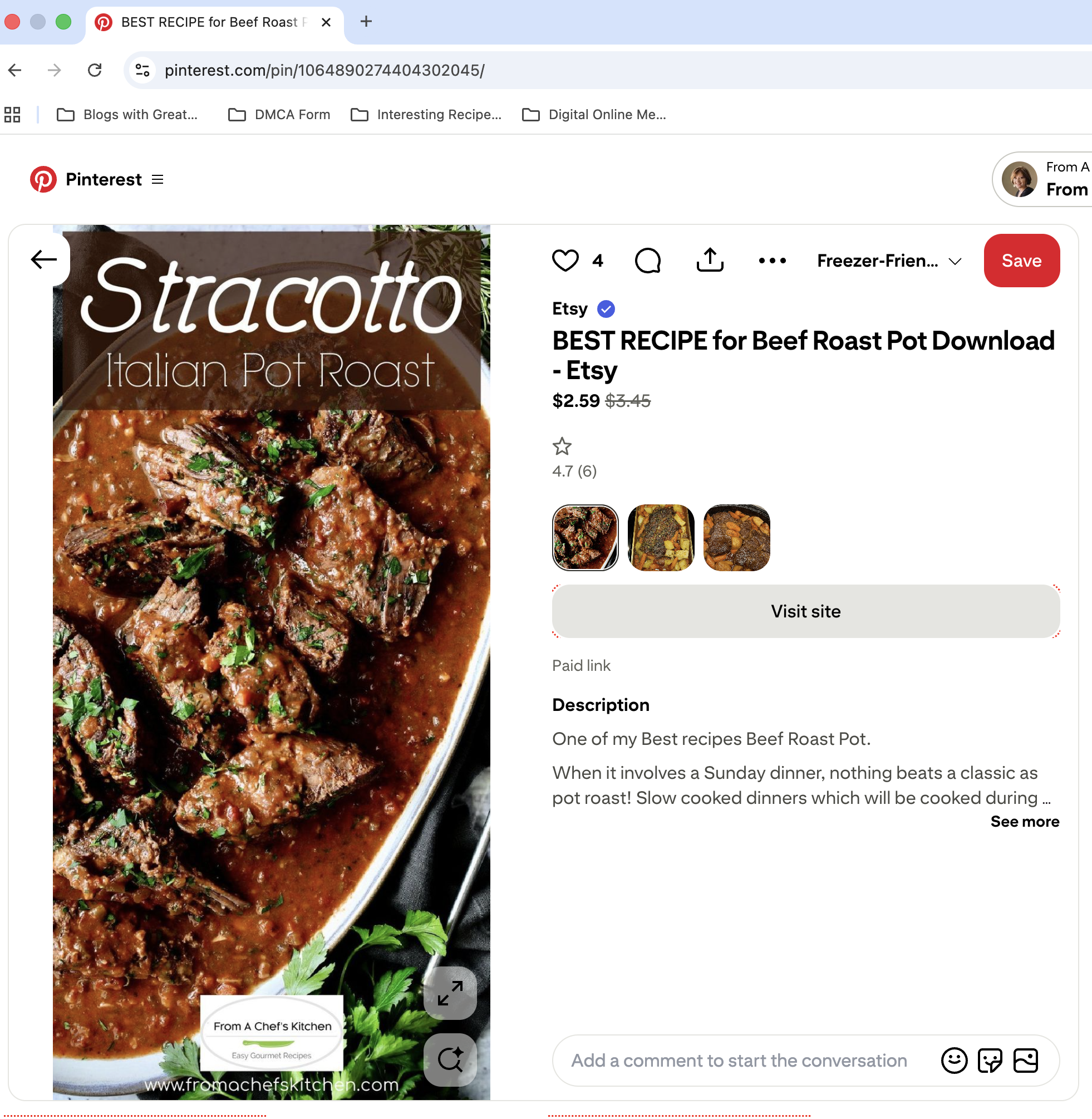
AI sloppers are now selling recipes there that you can get for free from thousands of real food bloggers. Many are stolen from real food bloggers, like my Italian Pot Roast recipe. It’s free here, but on Etsy, you’ll pay for it. And yes, there’s a sucker born every second because people actually pay for them.
Fortunately, I was able to get it removed from Pinterest; however, Pinterest has not always been responsive.
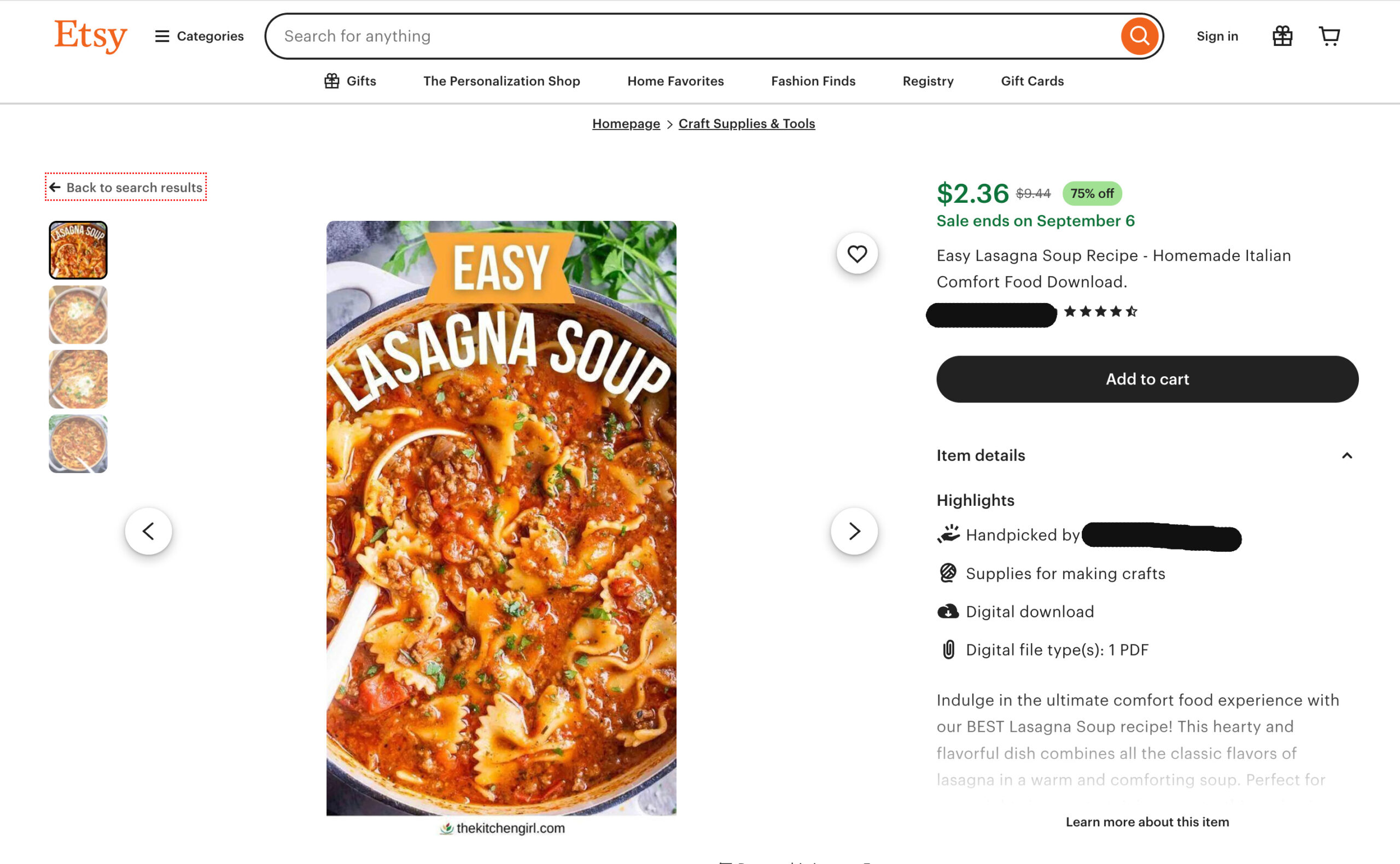
Here’s another example of how this shameless individual stole an image and didn’t bother to remove the original blogger’s name. Here’s her Lasagna Soup recipe for free: Lasagna Soup
Please do visit Etsy.com to support REAL artists, creators, and sellers, not those who have stolen content and recipes.
MORE RESOURCES
Realbloggers.org (Website of real, verified bloggers)
Futurism: Slop Farmer Boasts About How He Uses AI to Flood Social Media to Trick Older Women (Article)
HBO John Oliver Segment (Profanity Alert)
https://www.instagram.com/p/DKPLxn2tDxF (Jebb West Video, Profanity Alert)
https://www.instagram.com/p/DKer99dtb4H (Jebb West Video, Profanity Alert)
AI-Generated Recipes: Brilliant or a Recipe for Disaster (Podcast from Christina Hitchcock at Behind the Recipe)
FODMAP Everyday – How to Detect AI-Generated Recipes and Images Online
CNN – Baker Beware: How I Was Fooled by an AI-Generated Recipe
AI may be able to mimic food content, but it can’t replace the experience of a real cook in the kitchen. When you choose recipes from trusted sources, you know they’ve been tested, tasted, and written with you in mind.
With a real human food blogger, you have recourse when a recipe does not work out well, which is the rating and comment system. The FTC prohibits us from altering ratings. Because a human is behind the blog, we care about you and the results.
Here, you’ll always find recipes created by a real person, me, who has cooked them, tasted them, loved them, and made sure they’ll work in your kitchen. And yes, sometimes tossed into the trash or compost because they weren’t good enough to share with you.
I plan to update this post as I learn new things. If you ever have any questions or are wondering whether something is real, please reach out to me or other human creators you trust.
Thank you!
I’d love to hear what you think. In the comments, share your experience with AI-generated food content. I’m always interested in how readers navigate this new online food world!


This article is hugely informative. Thank you so much for detailing all the ways we can get taken in by AI Slop. I thought I was well informed but you have taught me I need to be even more alert. Great work and a real public service. Thanks.
Hi, Brenda, Thanks so very much and I really appreciate hearing that! There have been a couple of advancements lately where creators have to disclose whether something is AI. Don’t know if the sloppers will abide by that; seems only good people follow rules. Thanks again and thanks for reading!
Hi Carol, this is a super informative article. I’m sharing it on my Facebook page today. Thank you for pulling together all this info.
Hi, Katrin, Thanks so very much! Hope it enlightens even a few people.
Thank you for this. After reading this article long ago, I spent a few hours creating a set of bookmarks for myself of reliable recipe sites that all have the Raptive indicator, and I no longer use any search engine to look for recipes (including, of course, this site!). It’s more time consuming to visit individual sites, but it’s safer. And since I always end up on their main landing page before I initiate a search, I often stumble across newer recipes that I wouldn’t have imagined searching for. AI Slop is going to be a terrible thing for so many industries, it’s really discouraging. At least I am very elderly, and won’t be around for the worst of it, if that’s any silver lining for me…
Hi, KJOW, Thanks so much for getting in touch and letting me know how this article has helped. It really is a problem that many food bloggers are up against and fighting against. We know there are REAL people being affected and hurt by AI recipes. Please let me know if I can ever help or point you to other sites that I know are authentic. Take care!