Shrimp and Grits Casserole

This Post May Contain Affiliate Links. Please Read My Disclosure
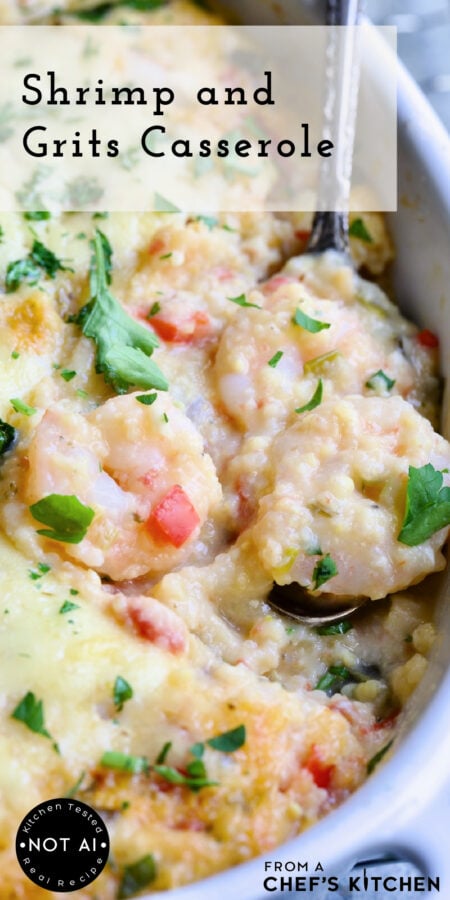
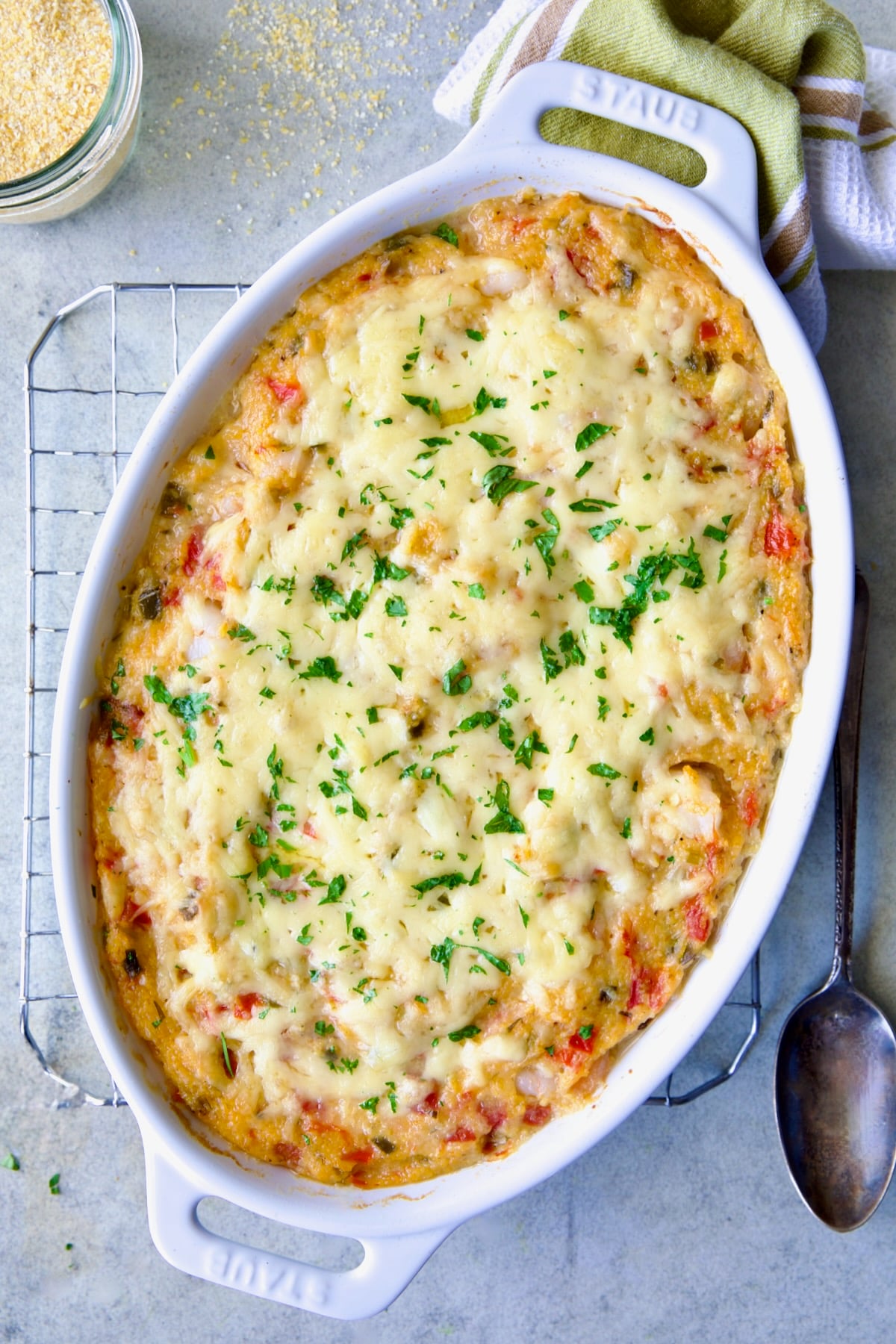
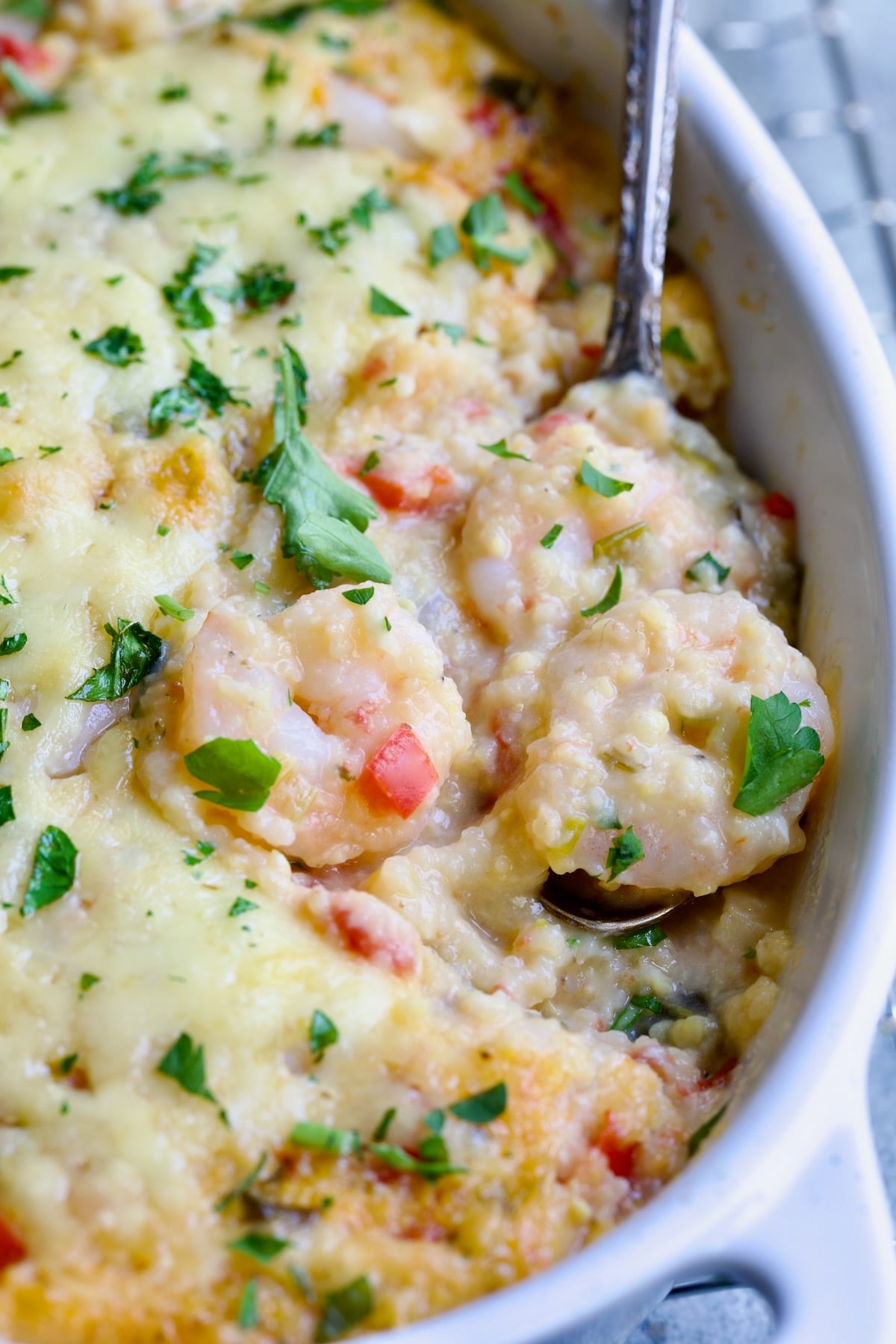
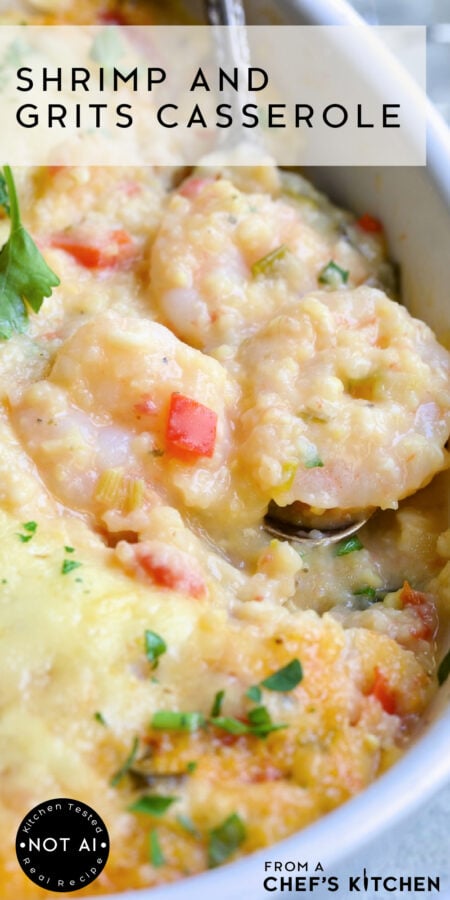
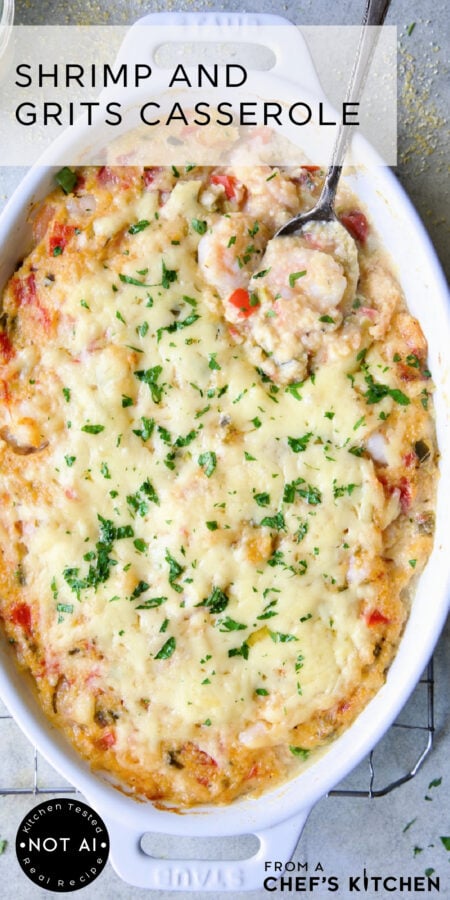
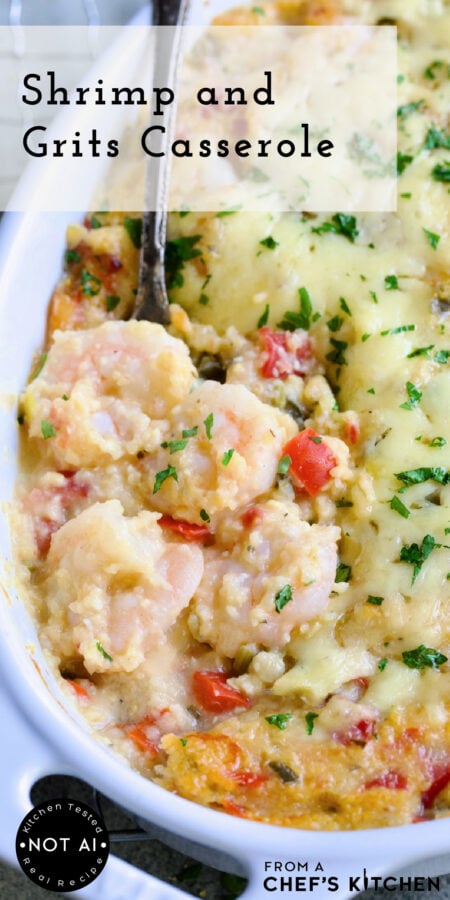
This spicy Shrimp and Grits Casserole is a tried-and-true twist on a Southern comfort food classic. Creamy grits, tender shrimp, melted Gouda, and a little heat come together in an easy, oven-baked dish that’s perfect for weeknights or casual entertaining. It’s the kind of crowd-pleasing dish that feels right at home on any table!
“Oh, my word! I made this–first time cooking grits. It is literally out of this world! Reheats well also. Will make again and again!”
a brief intro to shrimp and grits:
Shrimp and grits is a classic dish in Southern coastal cuisine which features a creamy ground corn porridge that resembles polenta.
Although the true birthplace of shrimp and grits is thought to be Charleston, South Carolina, it has since gained widespread popularity. This dish was even declared the official state food of South Carolina in 1976.
Initially intended as a breakfast dish for fishermen, it has evolved to become a favorite option for lunch, brunch, and dinner across the Southern United States. Here’s that classic combination in casserole form.
Why This Recipe is a Keeper!
Whether you’re hosting a family dinner or looking for a new comfort dish to enjoy, this shrimp and grits casserole hits all the right notes!
Before moving to the South 30 years ago, I never had grits, nor shrimp and grits. Frankly, grits scared me because I thought them to be bland and boring.
I finally tried them some years back when my husband and I stayed at an elegant bed-and-breakfast in Mississippi while taking the long way home from New Orleans. Breakfast was plated and served to all the guests and there they were in front of me: Grits.
Not boring at all, but creamy and delicious cheese grits!
After that day and after enjoying shrimp and grits at numerous restaurants if they’re on the menu, I’m now somewhat of a fanatic.
This Shrimp and Grits Casserole recipe is:
- A Pinterest favorite!
- Tried and true! Over 450 4 and 5-star ratings!
- Restaurant-quality!
- Ideal for entertaining! It’s perfect for brunch, lunch, or supper and equally at home on a holiday table or weeknight.
- Endlessly adaptable! You can dial it up or down depending on your audience with smoked gouda or pepperjack cheese. Add andouille or ham for smokier depth. Crab, anyone?
- Make-ahead! Unlike traditional shrimp and grits, the casserole format allows you to prep components in advance and bake when needed, making it ideal for brunches, holidays, or entertaining.
Creamy, crowd-pleasing, and versatile, it’s the kind of dish that earns a permanent spot in your entertaining rotation!
How to Make shrimp and grits casserole:
Recipe Ingredients:
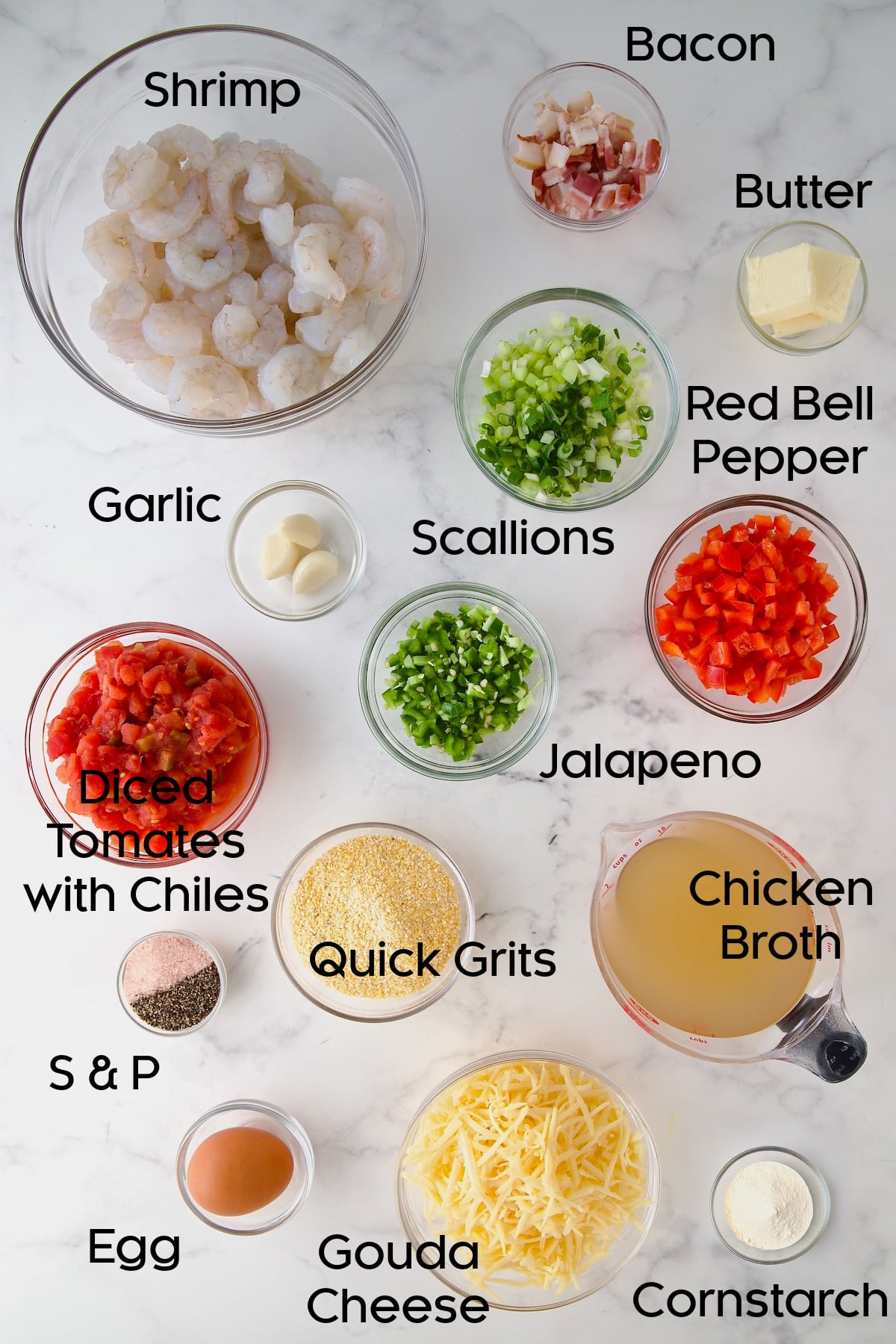
Here’s everything you’ll need to make this shrimp and grits casserole recipe. The exact quantities are on the recipe card below.
Ingredient Notes and Substitutions:
- Shrimp: It’s essential to always use wild-caught U. S. Gulf shrimp. They are much more resilient to reheating in a casserole, unlike farmed shrimp, which most certainly will become rubbery. I used 31-40 count, which is considered “medium-large.” You can use larger shrimp or smaller shrimp. However, I found the 31-40 count medium-large to be the right size–substantial, yet easy to manage on the plate.
- Bacon: If you don’t consume pork, use turkey or beef bacon. You can also use diced andouille sausage.
- Diced Tomatoes with Green Chiles: This shrimp and grits casserole recipe calls for a 10-ounce can such as Ro-Tel. You can substitute regular petite-diced tomatoes if you want to dial down the heat. Drain them well as the additional liquid could result in a soupy result.
- Jalapeno: Use as little or as much as you wish. Removing the seeds will cut the heat if you want a milder casserole.
- Quick Grits: Quick-cooking grits (not instant) work well in a casserole like this because of the other textures. Stone-ground grits will take much longer to cook, so cook them separately first, following the package directions, then add the vegetable combination and the remaining ingredients. I don’t recommend instant for this dish. They cook too fast and can turn mushy quickly.
- Chicken Broth: Can also use fish stock.
- Gouda Cheese: Gouda cheese melts beautifully and has a mild flavor, so it doesn’t compete with the shrimp. Smoked Gouda, Monterey Jack, or Pepperjack will also work well.
- Cornstarch: Helps to thicken and reinforce the casserole’s structure without changing the flavor. Also keeps it gluten-free.
Step-By-Step Instructions:
- Gather and prep all the ingredients.
- Preheat the oven to 375 degrees.
- Lightly grease a 1 1/2 – 2-quart baking dish with oil, butter or cooking spray. Set aside.
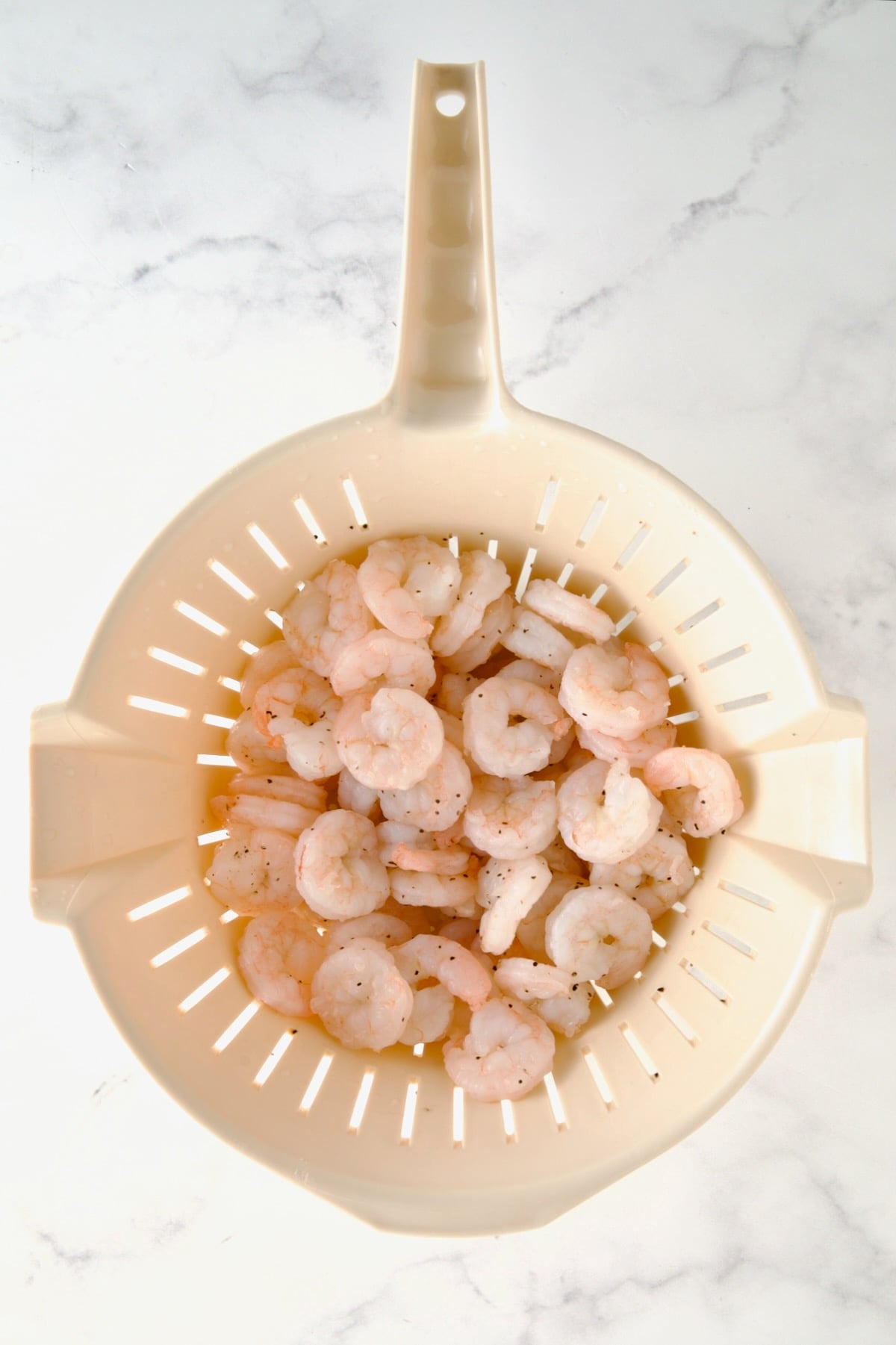
- Cook the shrimp: Place a colander in the sink to drain the shrimp. Then, bring a large, heavy saucepan of well-salted water (about 2 teaspoons) to a boil. Turn off the heat, add the shrimp, and cook for 10 to 15 seconds, or until they turn pink, stirring once or twice. Drain immediately into the colander and cool quickly under cold tap water. Alternatively, prepare an ice bath and cool the shrimp in that. Drain the shrimp and pat dry.
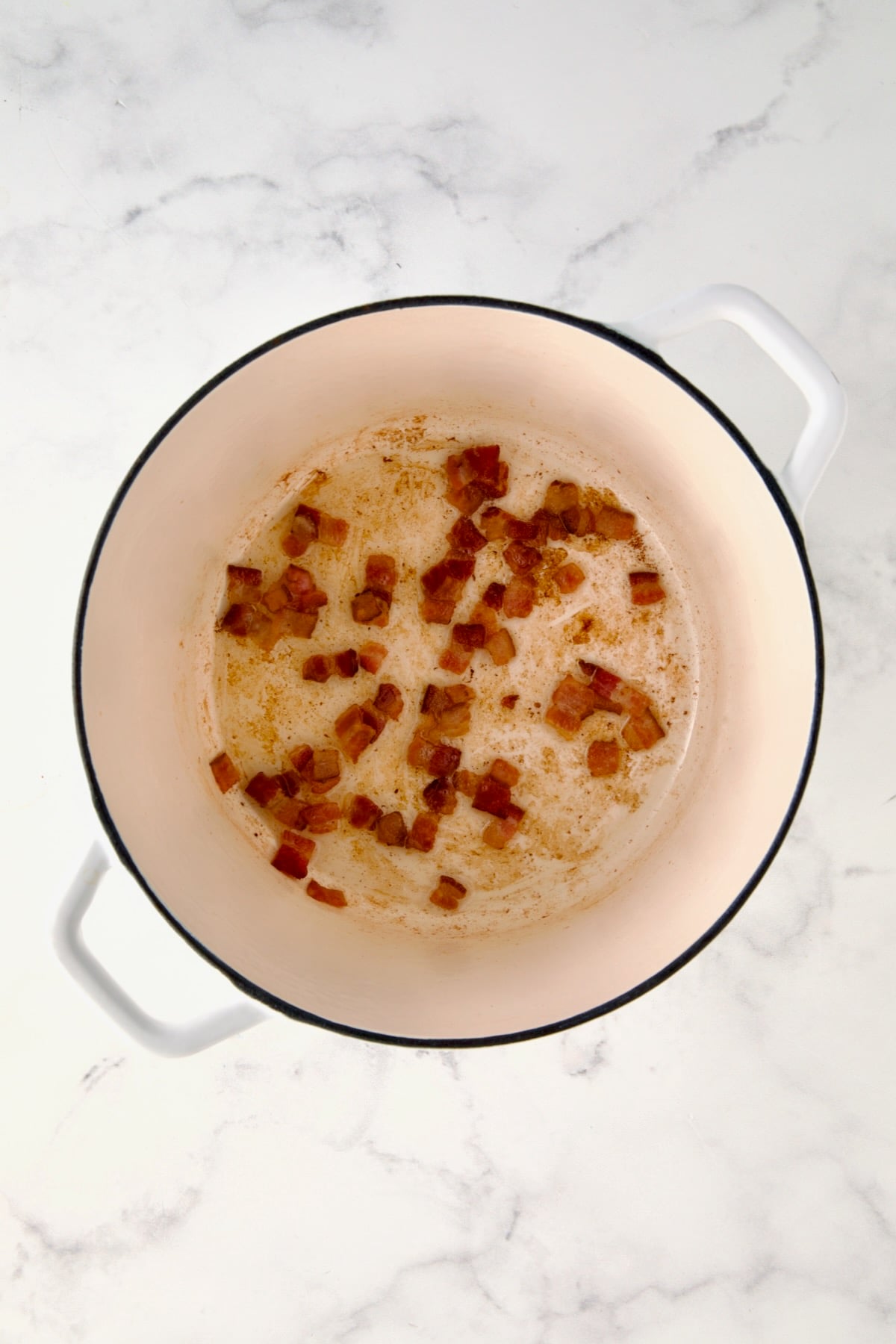
- In a heavy saucepan, cook the bacon over medium heat until browned and crispy. Transfer the bacon to a paper towel-lined plate with a slotted spoon, reserving the drippings in the saucepan.
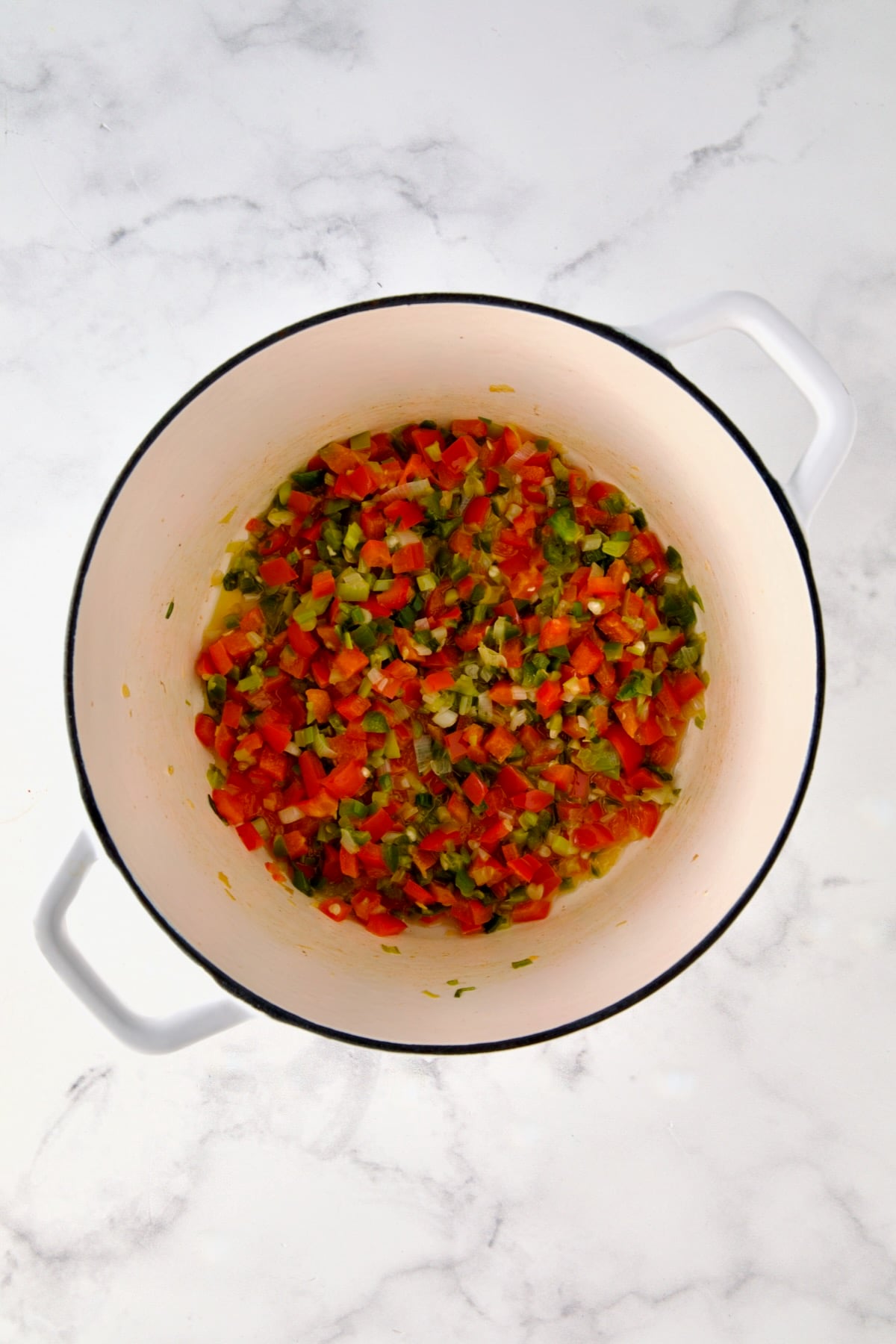
- Keep the heat on medium and add the butter to the bacon drippings. When melted, add the scallion, red bell pepper, and jalapeño pepper. Cook for 4 to 5 minutes or until softened.
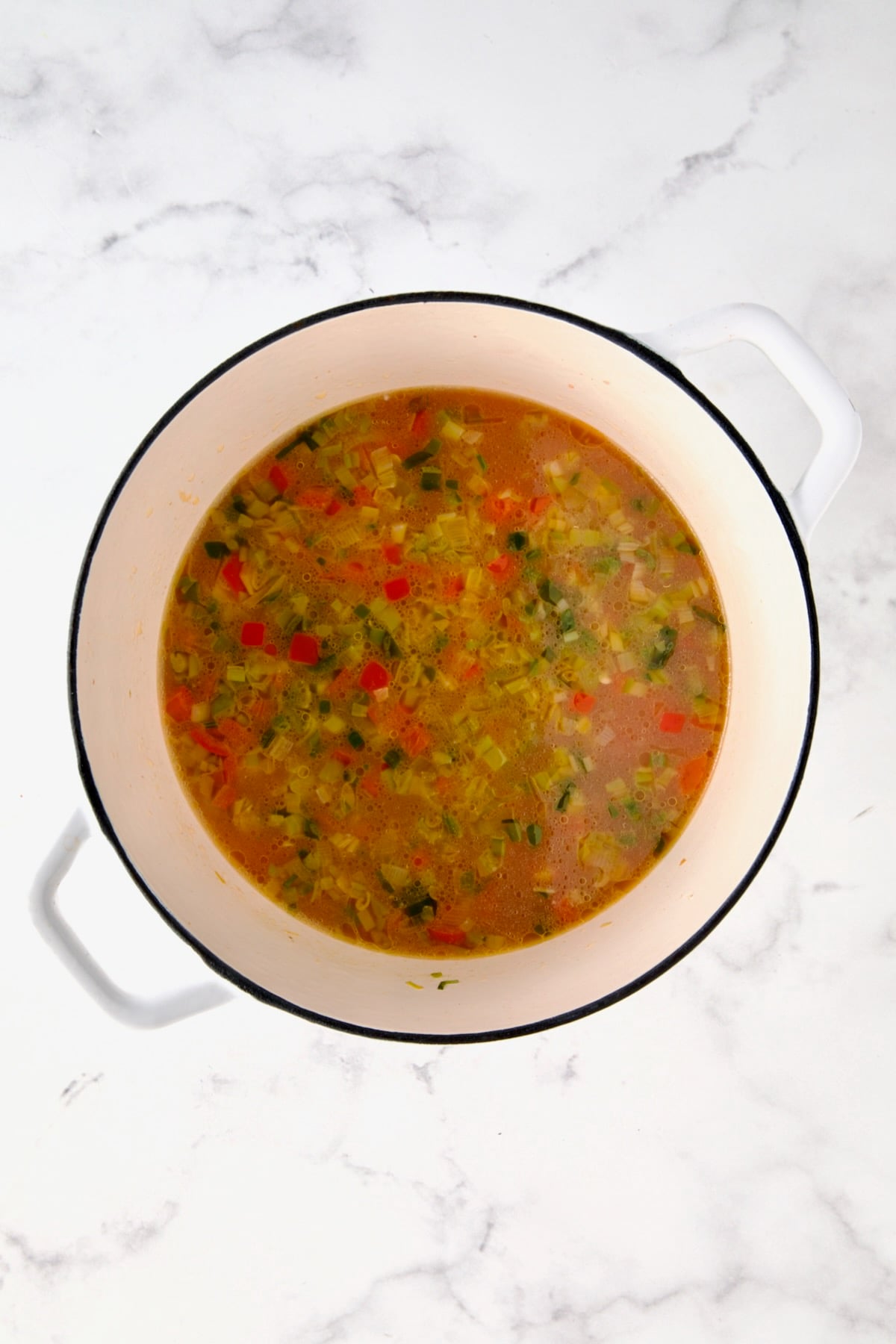
- Stir in garlic, diced tomatoes with chiles, and chicken broth (or fish stock). Bring to a boil.
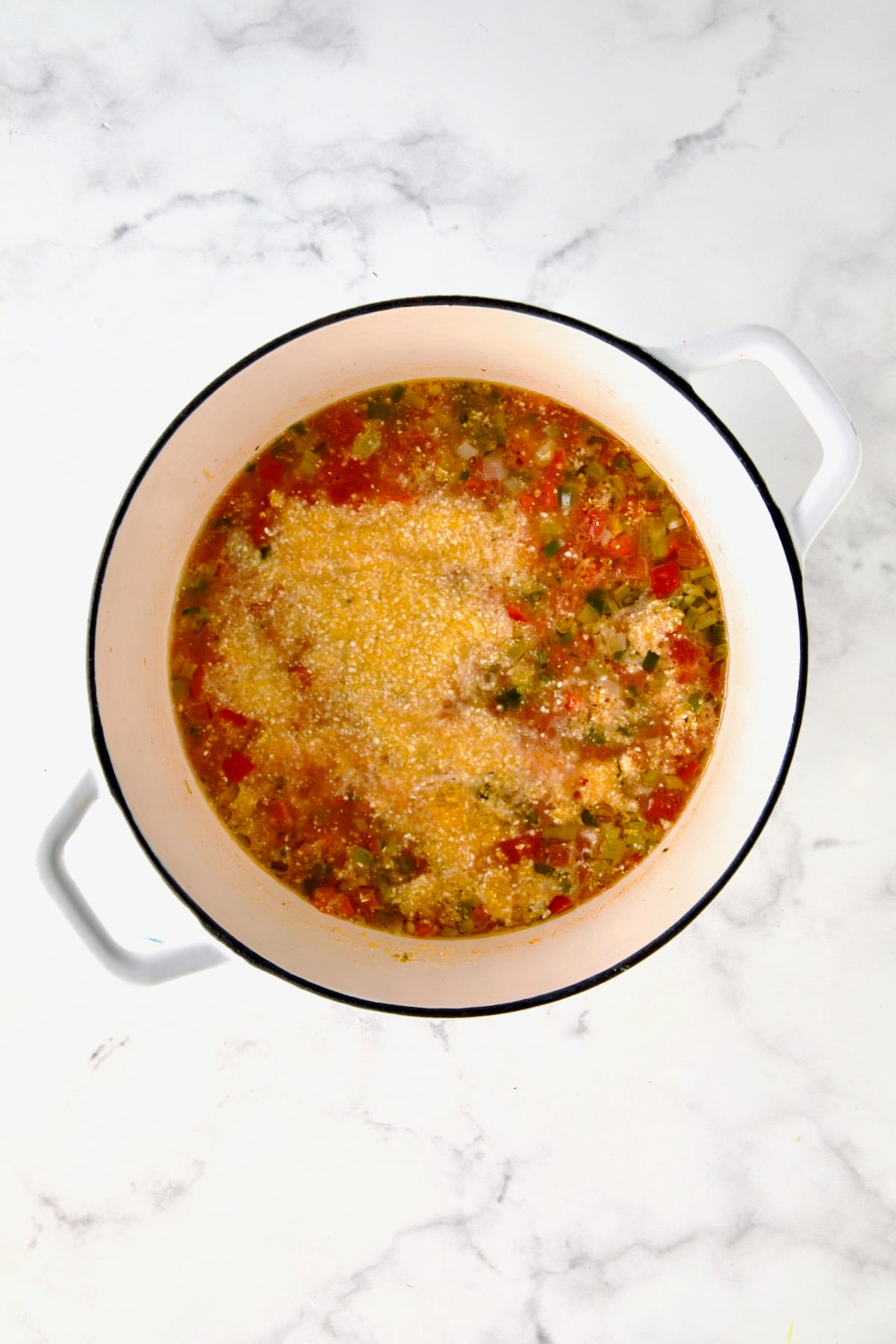
- Slowly stir in the grits. Return to a boil.
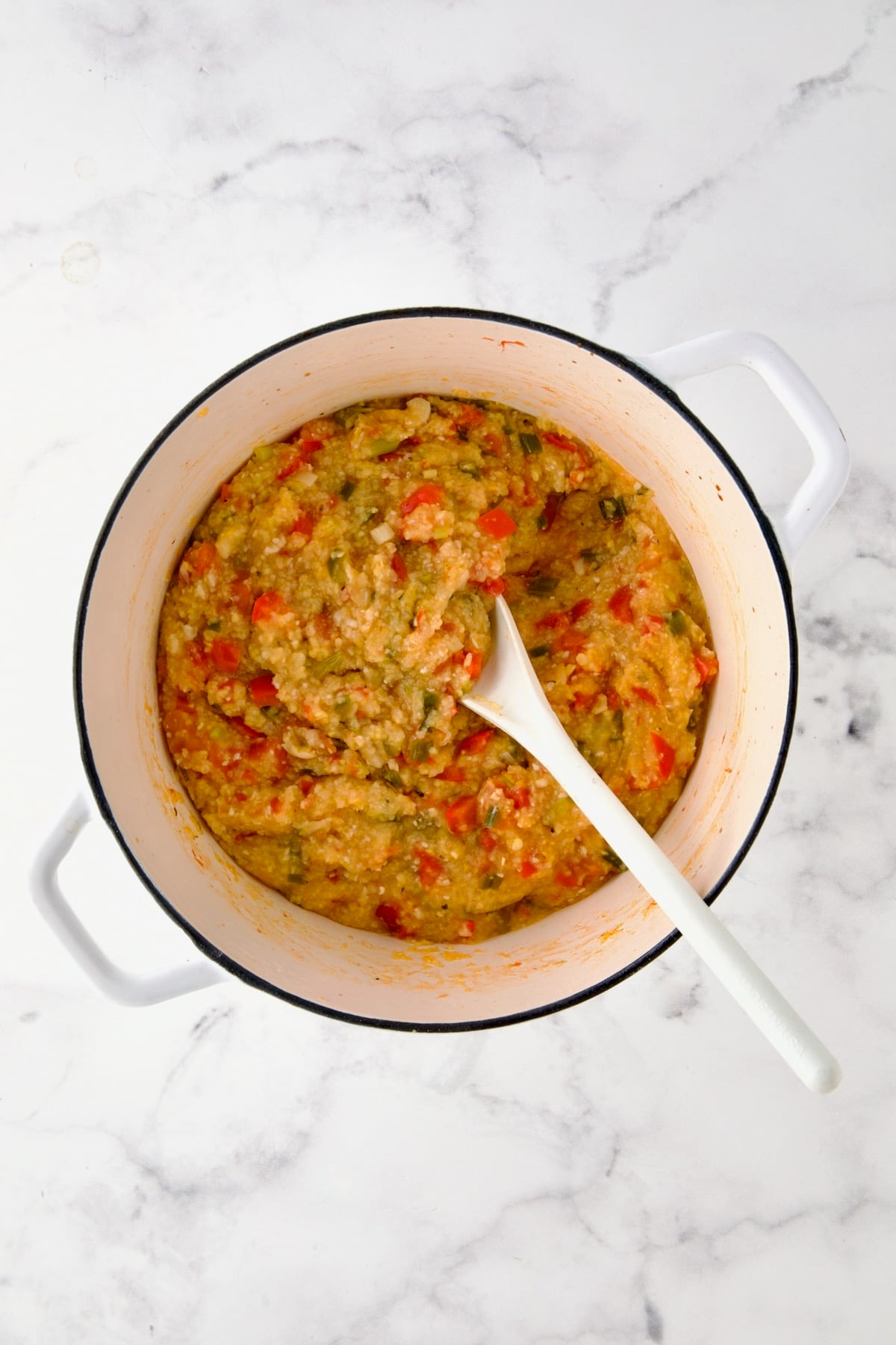
- Reduce the heat to low. Simmer, stirring occasionally, for 5 to 7 minutes or until thickened. Remove from heat and cool 15 minutes. Taste and season to taste with salt and black pepper.
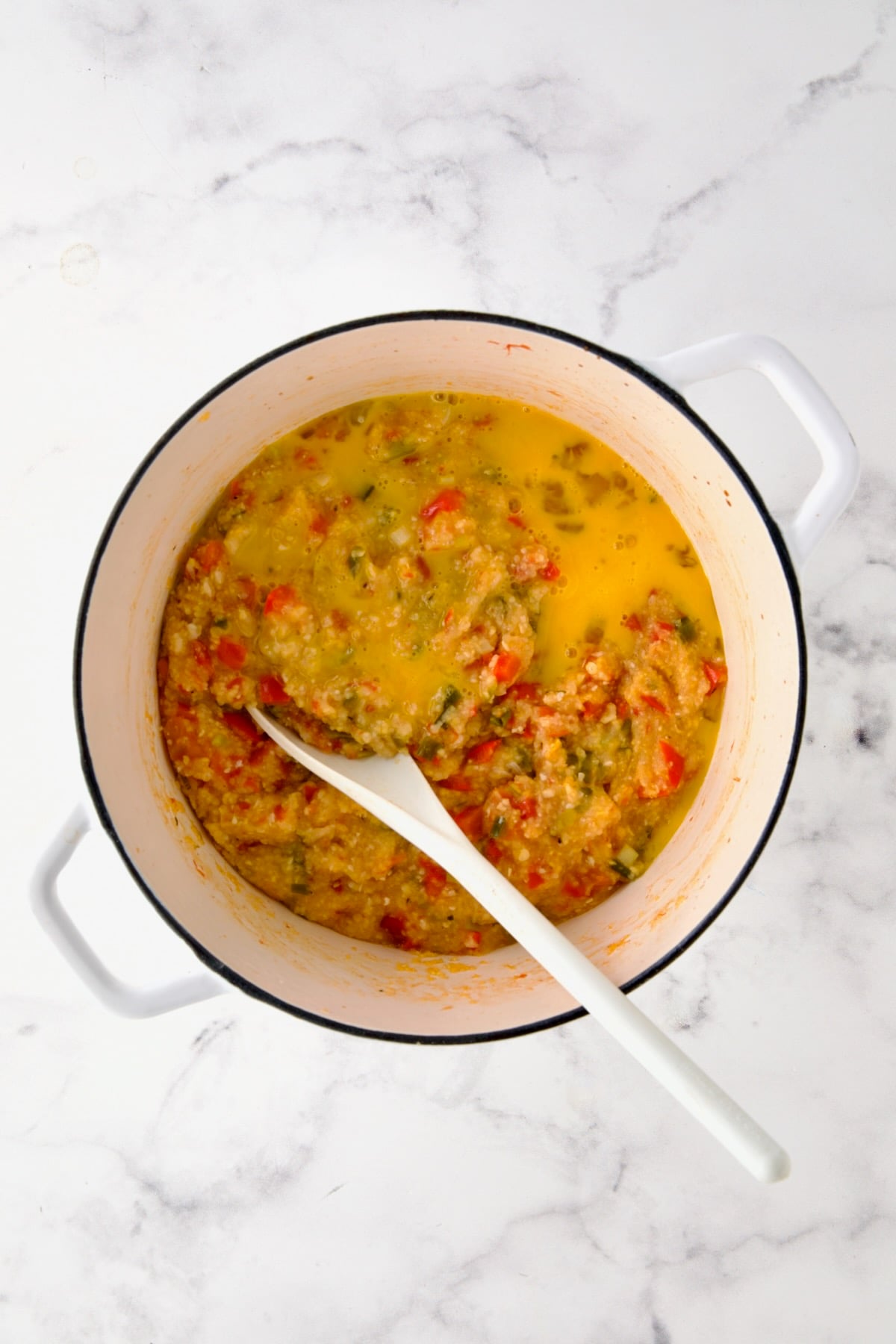
- Whisk the cornstarch into the egg, then stir it into the grits …
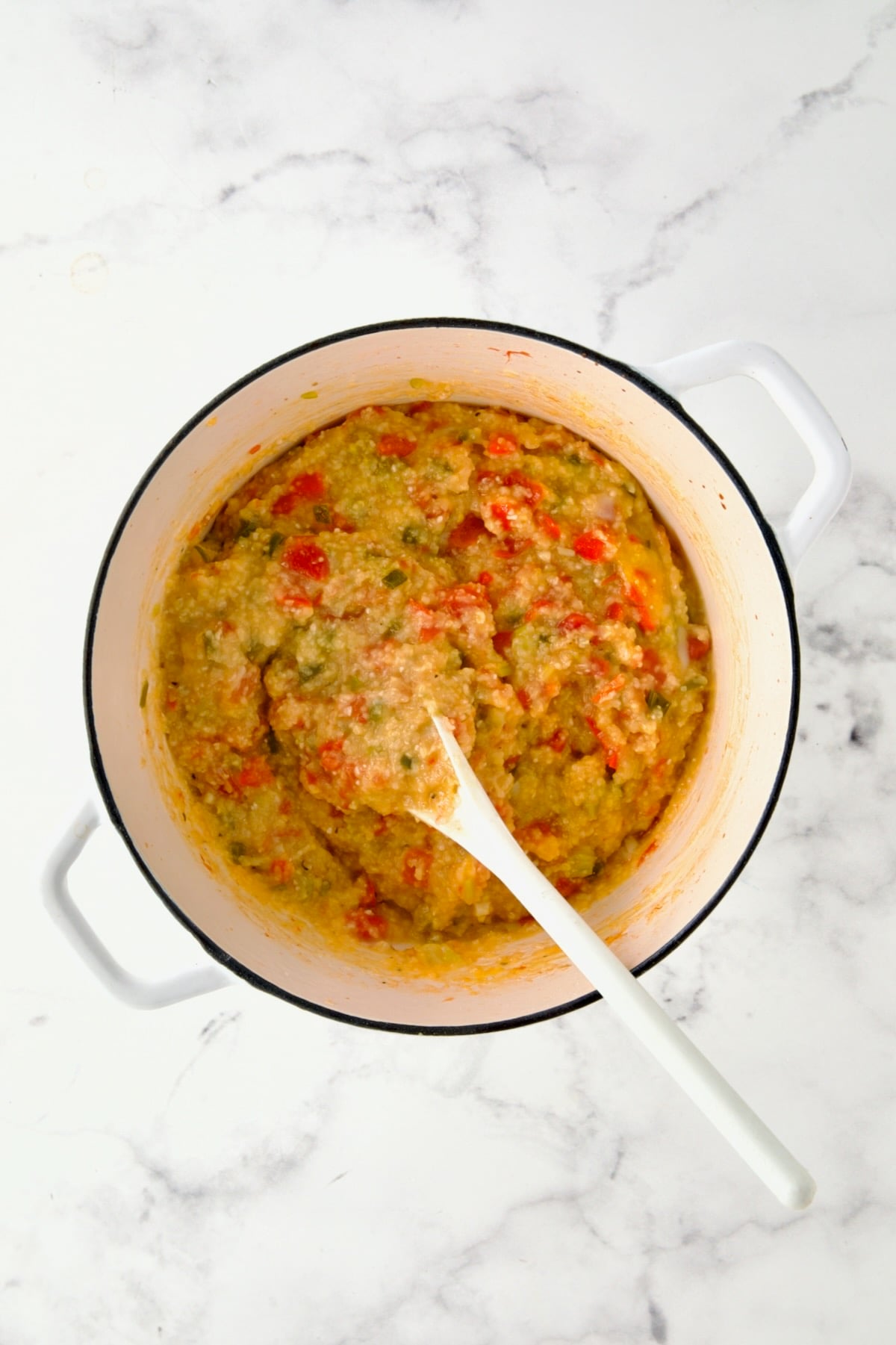
- … and fully incorporate.
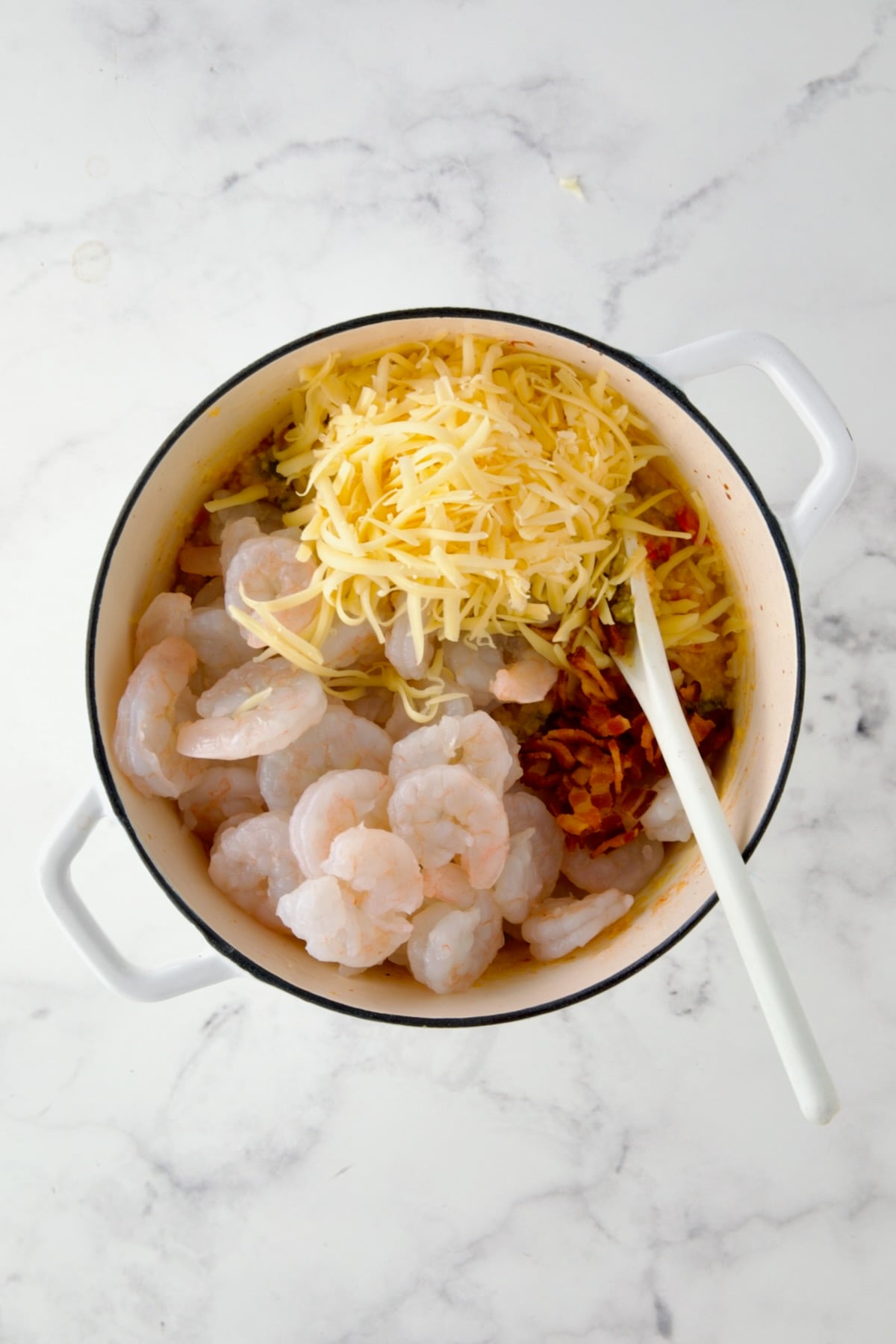
- Add the the shrimp, bacon, and 1 cup cheese …
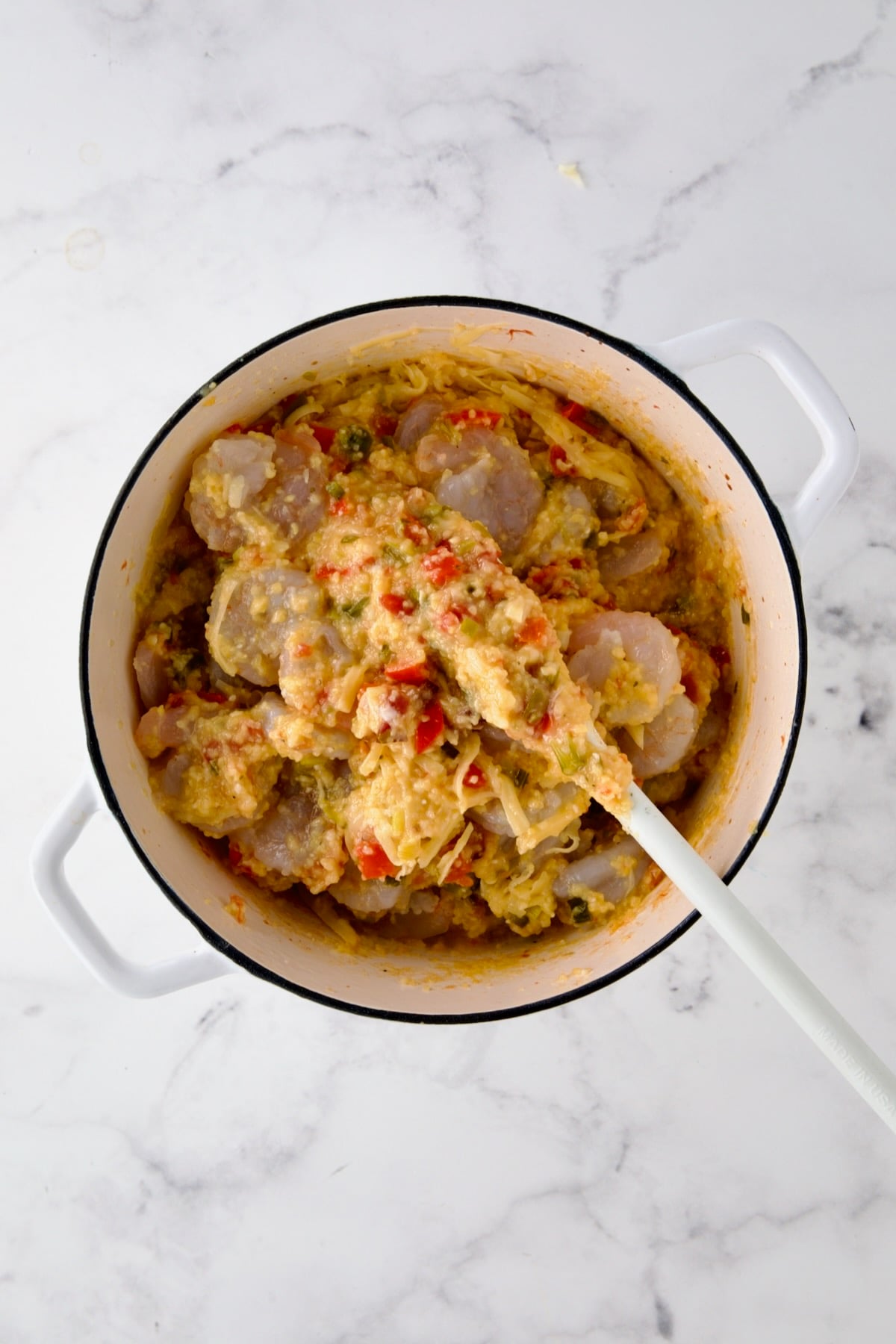
- … and fold it in.
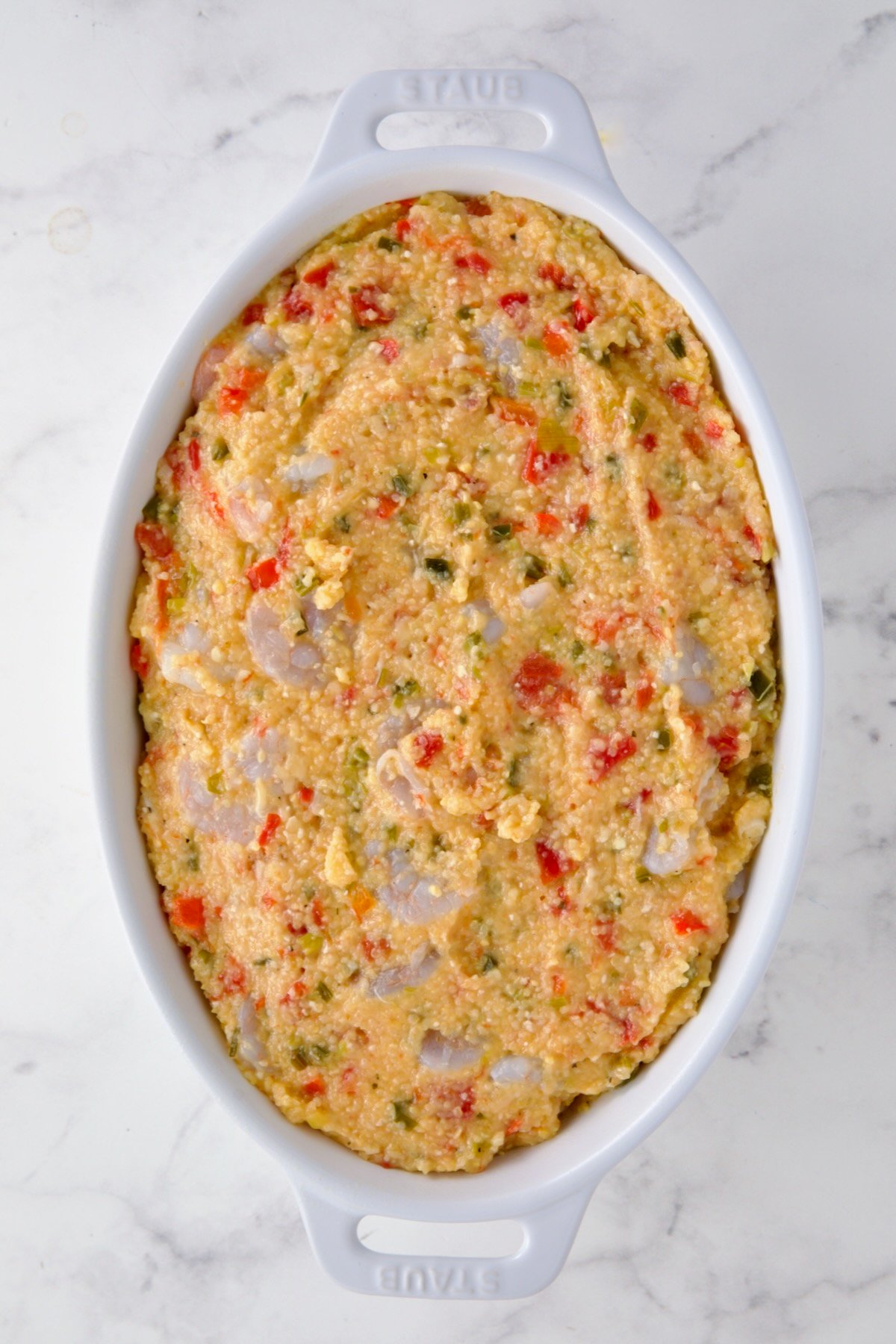
- Transfer to the prepared baking dish with more grits on the top than shrimp.
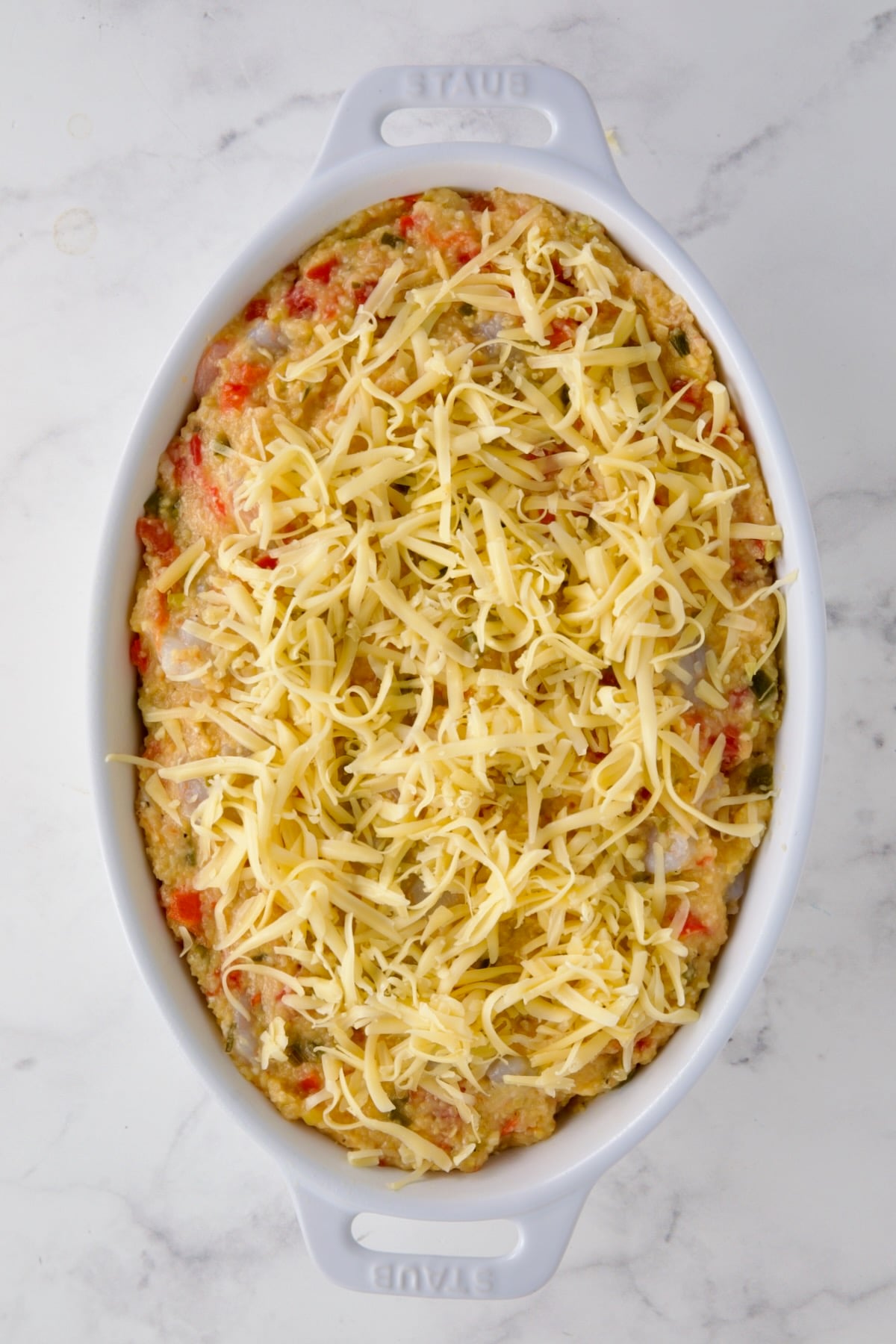
- Sprinkle with the remaining 1/2 cup cheese.
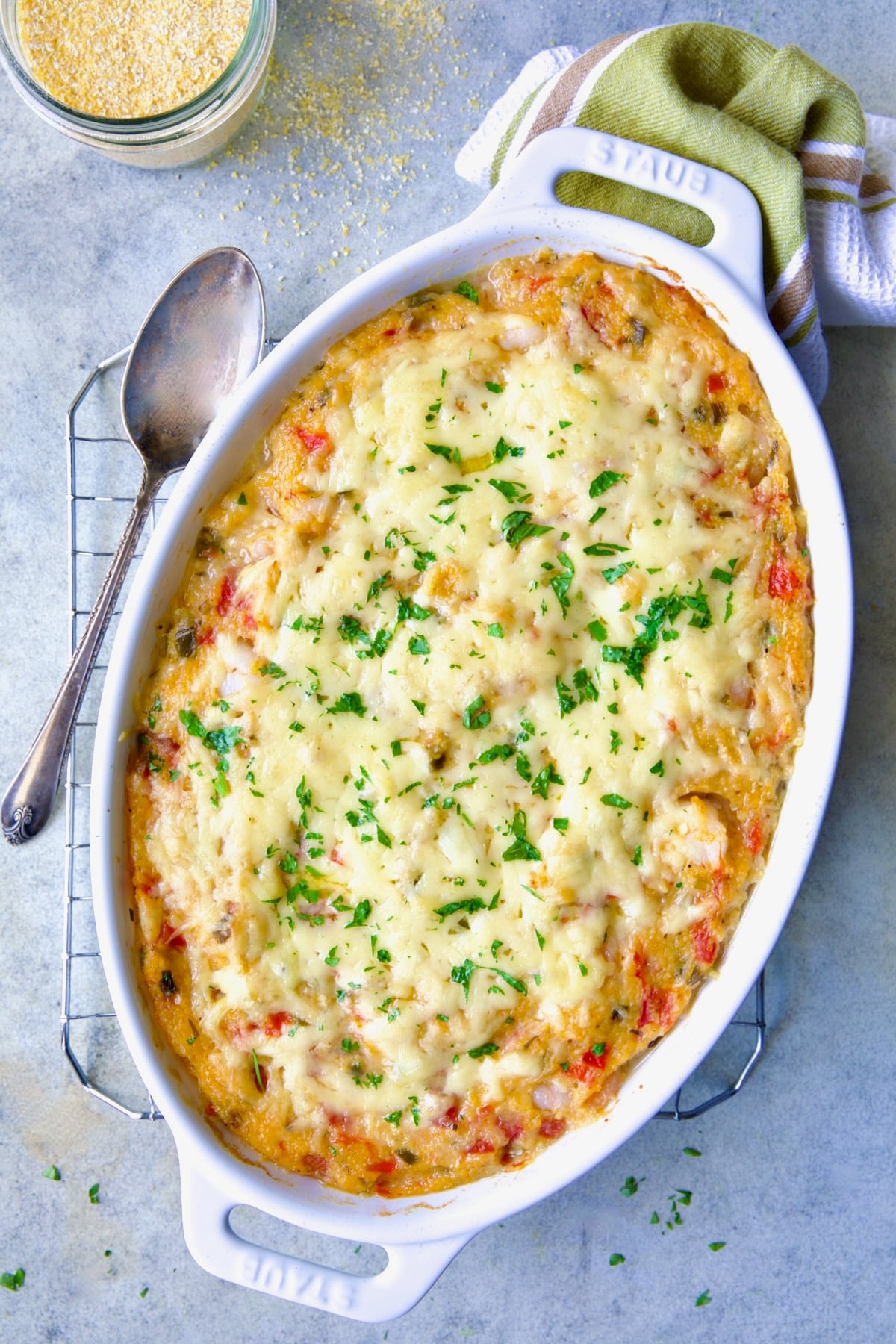
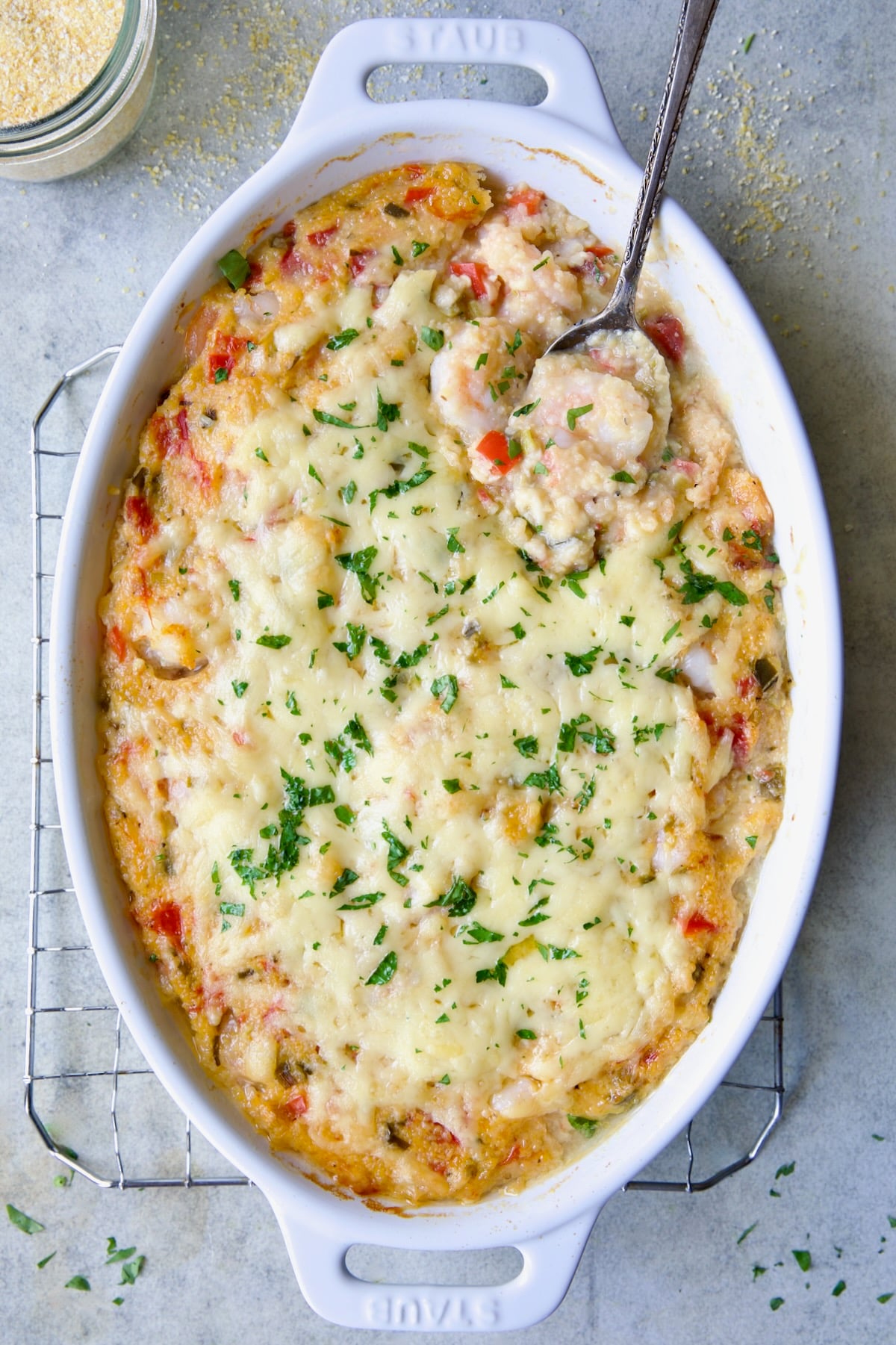
- Bake for 30 to 35 minutes or until heated through and bubbling. The casserole should be set around the perimeter with an internal temperature of at least 165 degrees. Let stand 5 to 10 minutes before serving
Chef Tips and Tricks:
- A shallow 1½ to 2-quart dish works best. Deep baking dishes take longer to set.
- Nearly all commercial shrimp sold is individually quick-frozen. The shrimp sold in the seafood display case has likely been thawed. If purchasing thawed shrimp, be sure to use it within a day or two and don’t refreeze it. I prefer to purchase frozen shrimp and thaw it myself.
- Be very careful not to overcook the shrimp. You don’t need to boil the shrimp; boil the water. Generously salt the water and get it to a rolling boil. Then, turn the heat off. Drop the shrimp into the water, stir it, and when the shrimp turns barely opaque (which happens quickly), remove it and cool it either under cold tap water or in an ice bath.
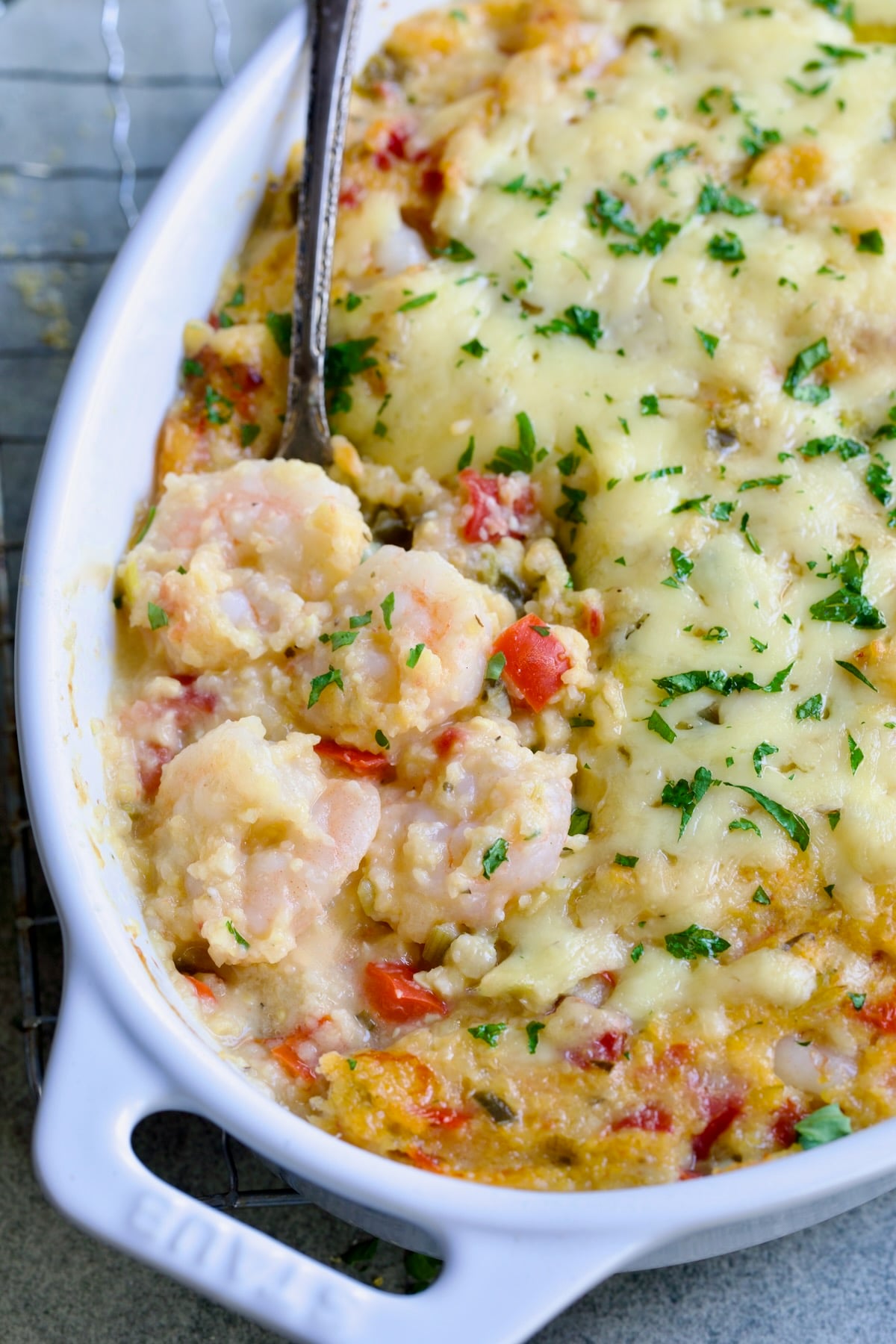
- The grits should be thick and spoon-standing before anything else is added. Undercooking the grits can result in a soupy casserole. (See Step #6 and how the grits hold their form.)
- Taste and season the grits with salt before adding the egg/cornstarch and remaining ingredients.
- The egg/cornstarch must be added in a separate step, rather than mixing it in with the bacon, shrimp, and cheese, so it distributes evenly throughout the grits. This ensures even distribution and proper binding. It’s also essential to let the grits cool for 15 minutes before adding the egg. If you add it too quickly, the egg could scramble. This also gives the grits additional time to thicken up before the egg (which is liquid) is added.
- Bake uncovered so excess moisture can evaporate. However, if the cheese browns too much, cover it loosely with aluminum foil.
- Let the casserole rest for 5 to 10 minutes before serving so the grits firm up. The perimeter of the casserole should be set, with the interior remaining creamy.
Recipe FAQs:
Yes. However, stone-ground grits require a much longer cooking time, so prepare them separately according to the package directions before incorporating the vegetable mixture and remaining ingredients.
Yes, I highly recommend it. Uncooked shrimp can create additional liquid, resulting in a soupy casserole. There is also a food safety concern. As long as you use wild-caught shrimp, don’t boil the shrimp, overcook it, and cool it promptly; it will hold up well to being reheated in the casserole.
Yes, I recommend it. I tested a batch of grits without the egg, and they were dense after baking.
A shrimp and grits casserole can turn out soupy for several reasons:
>>The grits were not completely cooked, and the grits mixture was not thick enough.
>>There is too much liquid. Excess moisture from ingredients like shrimp, vegetables, or tomatoes can thin the mixture if they aren’t well-drained first. The typical ratio of quick grits to liquid is 1/4 cup of grits to 1 cup of liquid. This shrimp and grits casserole recipe uses 3/4 cup of grits to 2 cups of liquid, so the extra 1/4 cup of grits helps absorb any additional moisture released by the vegetables and shrimp.
>>The casserole was made ahead of time and covered before it completely cooled, allowing steam to drip back down onto the casserole.
>>The casserole was covered while baking.
>>The resting time was skipped. Letting the casserole sit for 10 to 15 minutes before serving allows the grits and eggs to finish firming up, often fixing what looks like a soupy texture straight out of the oven.
Yes, it can be assembled 24 hours in advance. Let it cool completely before covering it for refrigeration so condensation doesn’t drip onto the casserole, which can make it soupy. Let it sit at room temperature for 30 minutes before placing it in the oven.
Bake uncovered so moisture can evaporate. Cover loosely if the cheese is starting to look brown. Baking time may be longer if the casserole is super cold from the refrigerator.
Yes, cool uncovered, wrap securely, and freeze. Thaw in the refrigerator for at least 24 hours. Let the casserole sit at room temperature for 30 minutes or so before placing it in the oven.
Bake uncovered so moisture can evaporate. Cover loosely if the cheese is starting to look brown. Increase baking time if the casserole is super cold.
Serve with:
- Garlic Green Beans
- Easy Braised Southern Greens Recipe
- Grilled Corn Succotash
- Fried Cabbage with Bacon
More shrimp and grits recipes:
- Smothered Shrimp and Andouille Sausage with Creamy Parmesan Peppercorn Grits
- Cauliflower Grits with Gouda Cheese and Blackened Shrimp
- Pumpkin, Chipotle and White Cheddar Grits with Bacon-Wrapped Shrimp
Get all my fish and seafood recipes at Fish and Seafood Recipes – From A Chef’s Kitchen.
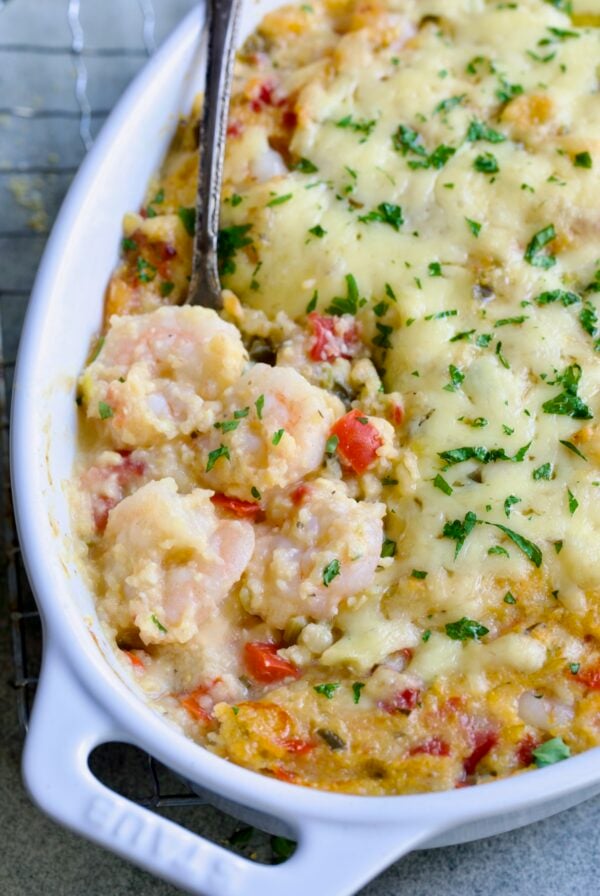
Shrimp and Grits Casserole
Video
Ingredients
- Cooking spray, butter or oil, for the baking dish
- 1 pound medium-large uncooked shrimp (31-40 count), peeled, deveined and tail removed
- Salt and freshly ground black pepper
- 2 slices bacon, chopped
- 3 tablespoons butter
- 1 bunch scallions (medium-width), white and light-green part only, chopped (scant 1 cup)
- 1 small red bell pepper, chopped (scant 1 cup)
- 1 medium jalapeño pepper, seeded if desired, finely chopped
- 3 cloves garlic, minced
- 1 can (10-ounce) diced tomatoes with green chiles, drained
- 2 cups chicken broth, or fish stock
- 3/4 cup quick-cooking grits, not instant
- 1 large egg, beaten
- 1 tablespoon cornstarch
- 1 1/2 cups shredded Gouda cheese, divided
- Chopped fresh parsley, for garnish (optional)
Instructions
- Preheat oven to 375 degrees. Lightly grease a 1 1/2 – 2-quart baking dish. Set aside.
- Cook the shrimp: Place a colander in the sink to drain the shrimp. Then, bring a large, heavy saucepan of well-salted water (about 2 teaspoons) to a boil. Turn off the heat, add the shrimp, and cook for 10-15 seconds, or until they turn pink, stirring once or twice. Drain immediately into the colander and cool quickly under cold tap water. Alternatively, prepare an ice bath and cool the shrimp in that. Drain the shrimp and pat dry.
- In a heavy saucepan, cook the bacon over medium heat until browned and crispy. Transfer the bacon to a paper towel-lined plate with a slotted spoon, reserving the drippings in the saucepan.
- Keep the heat on medium and add the butter to the bacon drippings. When melted, add the scallion, red bell pepper, and jalapeño pepper. Cook for 4-5 minutes or until softened.
- Stir in garlic, diced tomatoes with chiles, and chicken broth (or fish stock). Bring to a boil.
- Slowly stir in the grits. Return to a boil.
- Reduce the heat to low. Simmer, stirring occasionally, for 5-7 minutes or until thickened. Remove from heat and cool 15 minutes.
- Taste and season to taste with salt and black pepper.
- Whisk the cornstarch into the egg, then stir it into the grits and fully incorporate.
- Fold in the shrimp, bacon, and 1 cup cheese. Transfer to the prepared baking dish with more grits on the top than shrimp. Sprinkle with the remaining 1/2 cup cheese.
- Bake for 30-35 minutes or until heated through and bubbling. The casserole should be set around the perimeter with an internal temperature of at least 165 degrees. Let stand 5-10 minutes before serving
Notes
- It’s essential to always use wild-caught U. S. Gulf shrimp. They are much more resilient to reheating in a casserole, unlike farmed shrimp, which WILL become rubbery.
- If using stone-ground grits, cook them separately following the package directions. Then, add the vegetable combination and the remaining ingredients.
- Quick-cooking grits (not instant) work because of the other textures.
- I don’t recommend instant grits for this dish. They cook too fast and can turn mushy quickly.
- If you don’t consume pork, use turkey or beef bacon. You can also use diced andouille sausage.
- You can substitute regular, drained, petite diced tomatoes if you want to dial down the heat.
- Can use fish stock in place of chicken broth.
- Smoked Gouda, Monterey Jack, or Pepperjack will also work well.
- Can be assembled 24 hours in advance. Let cool completely before covering for refrigeration so condensation doesn’t drip onto the casserole, which can make it soupy.
- Let it sit at room temperature for 30 minutes before placing it in the oven.
- Bake uncovered so moisture can evaporate. Cover loosely if the cheese is starting to look brown.
- Baking time may be longer if the casserole is super cold from the refrigerator.
- Cool, wrap securely, and freeze.
- Thaw at least 24 hours in the refrigerator.
- Let the casserole sit at room temperature for 30 minutes or so before placing it in the oven.
- Bake uncovered so moisture can evaporate. Cover loosely if the cheese is starting to look brown.
- Increase baking time if the casserole is super cold.
Nutrition
Nutritional values are automatically calculated using unbranded products and are estimates only. Actual results may vary based on ingredients used and portion sizes. Adjust as needed for dietary restrictions, allergies, or health concerns.
 Like this? Leave a comment below!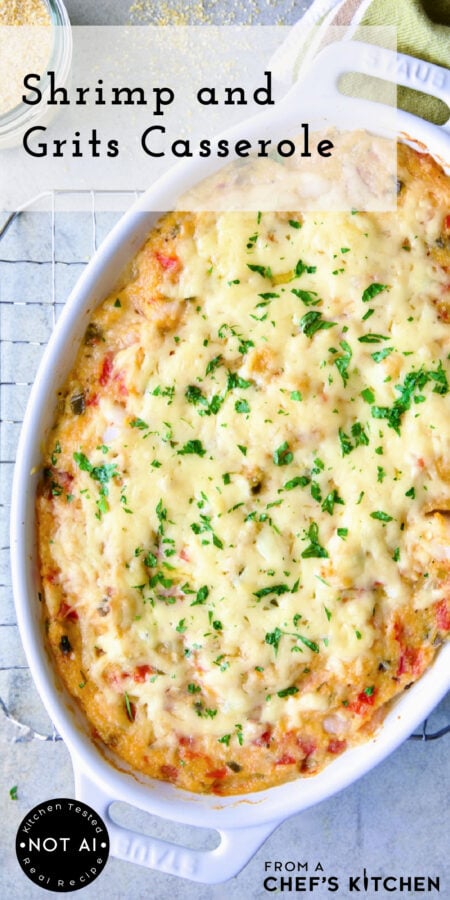



Hi, Robyn, Thanks so much for your question. If you can possibly get it assembled so she can bake it, that would be ideal. If you bake it, the shrimp will have been cooked three times. I’ve always found that wild-caught shrimp hold up much better to being baked in the casserole the first time because you’re essentially just heating it through. It’s also very important to not overcook the shrimp. Some readers have put the shrimp in the casserole raw with good results but for food safety reasons, I don’t like to tell people to do that. Hope this helps and let me know how it goes.
I’ve made this countless times and every time it comes out better than the last time. A few thoughts – while the frozen shrimp are defrosting I add the shells/tails to the vegetable broth for added flavor. I also add a few dashes of fish sauce to the vegetable broth. Also, I have used seafood stock and boiled the shells in that. After a full boil – reserve the broth and toss the shells. In addition to the spices on the recipe, I add some Old Bay seasoning and 1/4 teaspoon of Worcestershire. Even as I am typing this I am enjoying this fabulous meal. Add Red Lobster biscuits, a salad and wine for an exceptionally easy meal!
Hi, Carol, Thanks so very much!!! Love that you keep making this recipe your own. Your tweaks sound amazing!!! Thanks again!!
I’d love to make this for a friend so she can have it when she gets home from from a hospital stay. I am looking to have it cooked beforehand but will it reheat well? Will be awaiting your answer
I was really excited about this recipe. We love shrimp and grits. I hate to complain or be really critical but I am beyond disappointed. First. I barely cooked the shrimp so it would be raw in the middle before adding to the grits. They were tough and over cooked. ( I used Florida key west fresh) the grits were grainy. Perhaps I was hoping for too much but if you want shrimp and grits go with a traditional recipe.
Thanks so much for your feedback and so sorry this didn’t work for you. Hard to say what went wrong; this recipe has over 200 4 and 5-star ratings. You didn’t say anything about the flavor so am guessing that was okay? Did you use quick-cooking grits and not stone-ground?
I have made this several times now. The first time I made it for my college age son and I and I told him he could take some of the leftovers and hit took all but maybe four bites. My husband came home to have just enough to know he missed out. I made it again for us and our other 13 yr old the next day! They loved it! Making again for Mother’s Day brunch tomorrow! Thanks for the recipe!
My 91-year-old very southern mother-in-law lives with us. I made this tonight for dinner as she is super fond of grits. We all really liked it. Love the spice. Having never made grits before I am curious as to how thick this should be when done. Ours was soupy enough that I served it in bowls. Did I goof? Thanks for the recipe.
Hi, Dee Ann, Thanks so very much for your feedback. I know some people have had that problem. It shouldn’t be stiff but should still be able to be spooned up easily. I compared my recipe to a Southern Living recipe and theirs calls for 4 cups of liquid to 1 cup of grits while mine is 2 cups of liquid to 2/3 cup grits. The diced tomatoes with green chiles will add a small amount. I will retest this recipe very soon and make adjustments if necessary. Thanks again and glad you enjoyed the flavor!
My sister-in-law made this when my husband was at her house without me. He absolutely raved about it so, of course, I asked for the recipe. We follow it exactly but use raw shrimp and I use long-cooking stone-ground grits. I simply keep an eye on it during the 20 minutes it needs to cook and add liquid as needed. It not only comes out perfect but she said it freezes well. On a recent fishing trip, my husband got the opportunity to confirm that. It doesn’t last long enough in our home to make it to the freezer. Love it!
Hi, Sandra, Love that! Thanks so much and so glad everyone enjoys!
I made this recipe as written. I failed to notice that the amount of grits had been changed but, while I was making mine I decided that it was a little too soupy so I added some more grits. This actually ended up matching the recipe perfectly. It was delicious. You can’t beat shrimp and grits and Gouda cheese all I can say is Yum!
So I am sorry I posted this in reviews first 🙄
I am wondering if I need to thaw the shrimp before I add to grits?? I am nervous about overcooking shrimp so I may just use raw, I’m having a hard time finding big enough cooked shrimp with the tail already off. Still wondering if it should be thawed or can go in frozen. My guess is thawed.
Hi, Laurie, Thanks so much for your question. Definitely don’t use “store-bought cooked shrimp” as it’s probably farm-raised and it’s going to be tough. Cook the shrimp yourself. Just get a small saucepan of salted water boiling, add the shrimp and they’ll pretty much cook in 30 seconds. Drain and cool under cold tap water. I believe someone put the shrimp in raw and said it was fine. I always use wild-caught American shrimp and never had a problem with tough shrimp. Hope that helps!
Ah that’s makes more sense, you are just saying to cook it before hand! Not buy cooked shrimp 🥴!
I am making this tomorrow, so I appreciate the response.
Thanks so much, have great day!
Hi, should the shrimp be thawed first? I am having a hard time finding cooked shrimp bigger than small with the tail off. I’m a little nervous about overcooking it’s so may just use raw, but still wondering if it goes in frozen or thawed?
I’m concerned about the sodium content of this recipe. Does a serving really have over 3500 mg of sodium? What changes can I make to reduce the amount of sodium? Thanks.
Hi, Janet, Thanks so very much for your question. I calculated the nutritional information on 2 servings, but it really makes more like 3-4 servings so I recalculated on 3 which cut the sodium level by a third. I didn’t indicate an exact salt amount because I tend to go by taste instead. If you leave out the salt and use unsalted or low-sodium chicken broth–I’m sure that will bring it down substantially. You might also be able to find low-sodium diced tomatoes with green chiles. Thanks so much, hope that helps and hope you enjoy!
I just left it in my oven-safe fry pan. Worked wonderfully. My daughter is recovering from throat surgery, so I diced the shrimp. This recipe is delicious.
Hi, Joyce, Thanks so much and so glad you enjoyed. Hope your daughter is doing well and healing quickly!