Feijoada (Brazilian-Style Beef Stew)

This Post May Contain Affiliate Links. Please Read My Disclosure
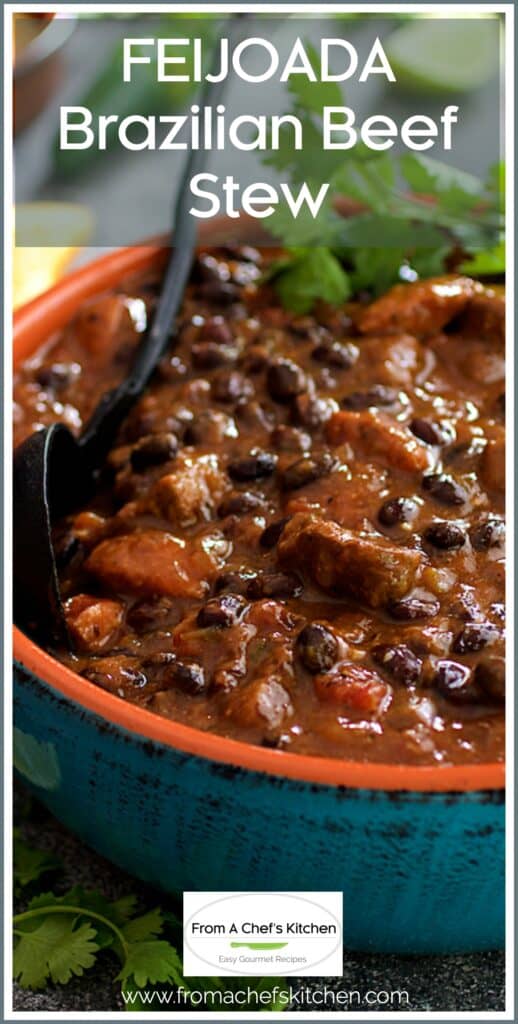
Feijoada, or Brazilian Beef Stew, is Brazil’s national dish. If made traditionally, it can take a day or two to make. This version is NOT 100% authentic; however, it’s easy to make and can be made with ingredients found in your local grocery store. A pressure cooker makes this version much faster!

What is a typical Brazilian meal?
Brazil is a country known for MEAT like these Beef Tips in Beer Sauce. I haven’t been there, however, my husband has traveled there on business several times. He has a lot of fond food memories of Brazil but said you can “hurt yourself” at a churrascaria which is where waiters serve hot grilled meats tableside fresh off the skewer.
What is feijoada made of?
Feijoada, or Brazilian Beef Stew, is another popular Brazilian meat dish. The meats used in feijoada vary by the cook, but it always includes black beans. On a recent trip to Portugal, we enjoyed their version of feijoada which was mostly black beans.
This version, inspired by a recipe in Cuisine at Home magazine, is NOT 100% authentic. However, it’s easy to make and can be made with ingredients found in your local grocery store.
My flavor-packed interpretation of the South American classic has cubed chuck roast, smoky kielbasa, a touch of fruitiness from orange juice, the spark of red wine vinegar and heat from chili powder.

How to make Feijoada (Brazilian Beef Stew):
- To make this classic long-cooked dish super-simple, I make it in an electric pressure cooker. If you’ve never used an electric pressure cooker, you’re missing out, my dear readers!
- With an electric pressure cooker, you don’t need a burner and you don’t even need to watch it. It’s electric so you just lock the lid, set the timer and do other things. My Cuisinart electric pressure cooker has been a real workhorse! Love it!
- First, however, you’ll need to brown the beef. Although electric pressure cookers have a browning feature, the heat is not high enough and the sides are too high to get a good sear on the beef so I sear it on the stovetop.
- Use as little oil as you can get away with and don’t crowd the pan. Crowding the pan causes the meat to steam rather than brown and it will turn a grisly gray color.

When browned properly, you’ll end up with beautiful, caramelized beef ready for your pressure cooker.

- Electric pressure cookers don’t go all the way to 15 psi (pounds per square inch) of pressure. Instant Pots only go to 12 psi. Stovetop pressure cookers do go that high, so, depending upon which pressure cooker you use, you’ll need to adjust the cooking time. Here’s a great article from Fine Cooking Magazine all about pressure cooking: The Science of Pressure Cookers
- To make this stew the old-fashioned way, you can also do it in a 325-degree oven or on the stovetop. This is also a great dish for your slow cooker.
- When the stew is done, release the pressure as gradually as possible. If done too quickly, the meat will seize up and turn tough. I use a damp kitchen towel to hold the pressure release valve for slow release.

- Add canned black beans that have been drained and rinsed. Then, stir in a cornstarch slurry to thicken it. Bring it back up to a simmer for a few minutes. Turn the pressure cooker off to let the meat rest. The stew will thicken up more as it stands.
What do you serve feijoada with?
This saucy stew is great over brown rice or by itself. Serve with fresh orange and lime slices, sliced fresh jalapeno, diced red onion and cilantro sprigs.
Let’s eat!
For more great beef stew recipes, be sure to try my:

Feijoada (Brazilian-Style Beef Stew)
Equipment
Ingredients
- 4 tablespoons canola oil, or vegetable oil, divided
- 1 large onion, chopped
- 2 large Poblano peppers, seeded and chopped
- 12 large cloves garlic, sliced
- 2 1/2 pounds chuck stew meat
- Salt and freshly ground black pepper
- 1 package (14-ounce) kielbasa, or smoked sausage, halved and sliced
- 1 cup orange juice
- 3 cups beef broth
- 1 can (15-ounce) diced canned tomatoes, undrained
- 2 tablespoons red wine vinegar, or to taste
- 2 tablespoons hot chili powder
- 2 cans (15-ounce) black beans, drained and rinsed
- 4 tablespoons corn starch, mixed with 3 tablespoons water
- Brown rice, optional
- Jalapeno slices
- Finely chopped red onion
- Orange and lime wedges
- Cilantro sprigs, for garnish
Instructions
- Heat 2 tablespoons oil in an electric pressure cooker on the “saute” setting. Add the onion and poblano pepper and cook, stirring occasionally until beginning to soften, approximately 5 minutes. Add the garlic and cook briefly until fragrant. Turn pressure cooker off.
- Heat 1 tablespoon oil in a large skillet or saute pan over medium-high heat. Season the beef with salt and black pepper. Brown the beef in batches, being careful not to crowd the pan, adding remaining 1 tablespoon oil as needed. Transfer each batch to the pressure cooker.
- Add kielbasa, orange juice, beef broth, tomatoes, vinegar and chili powder and stir to combine.
- Secure the lid on the pressure cooker. Set pressure cooker to “High” and let the pressure cooker do its thing for 21 minutes.
- Release the pressure as s-l-o-w-l-y as possible. Stir in black beans and corn starch slurry. Set pressure cooker to “simmer” and simmer gently until thickened. Let stew rest for 5 minutes to thicken more.
- Serve over brown rice (optional) with jalapeno slices, chopped red onion, orange and lime wedges and cilantro sprigs for garnish.
Notes
- Saute onion, pepper, and garlic as directed. Transfer to slow cooker.
- Brown beef as directed and add to slow-cooker. Add remaining ingredients (except black beans).
- Cook on High 4 hours or Low 8 hours. Add the cornstarch slurry near the end.
- Simmer uncovered on High until thickened.
- Stir in black beans and heat through.
- Cook on Low 2 hours or until beef is tender.
- Add black beans and corn starch slurry and simmer gently until thickened.
- Preheat oven to 325 degrees.
- Cover securely and braise for 2 to 2 1/2 hours or until beef is tender.
- Add black beans and cornstarch slurry and simmer gently on the stovetop until thickened.
- Use as little oil as possible and don’t crowd the pan when browning the beef. Crowding the pan causes the meat to steam rather than brown, and it will turn a grisly gray color.
- Electric pressure cookers don’t exceed 15 psi (pounds per square inch) of pressure. Instant Pots only go to 12 psi. Stovetop pressure cookers do go that high, so depending on which pressure cooker you use, you’ll need to adjust the cooking time.
- When the stew is done, release the pressure as gradually as possible. If done too quickly, the meat will seize up and turn tough. I use a damp kitchen towel to hold the pressure release valve for slow release.
- Make as directed, cool and refrigerate.
- Reheat on the stovetop or in the oven, stirring frequently until heated through.
- Cool completely and package in airtight containers as desired.
- Freeze 2-3 months.
- Thaw in the refrigerator, reheat on the stovetop or in the oven, stirring frequently until heated through.
Nutrition
Nutritional values are automatically calculated using unbranded products and are estimates only. Actual results may vary based on ingredients used and portion sizes. Adjust as needed for dietary restrictions, allergies, or health concerns.
 Like this? Leave a comment below!






Feel better, Jane? If you would have actually read the post, I state: “This version, inspired by a recipe in Cuisine at Home magazine, is not 100% authentic. However, it’s easy to make and can be made with ingredients found in your local grocery store.” WHAT is wrong with possibly introducing a simplified version of a dish to an audience that may not EVER get to travel to Brazil as you obviously have which now makes you an expert. Here is a Feijoada recipe from Olivia’s Cuisine that, OMG has beef. And is that some type of red chile in the corner of one of the photographs? Feijoada. And Olivia is Brazilian.
Just do a little research, Jane. If you’re such an expert on global cuisines, please start a food blog.
Hi Carol,
Just wanted to thank you for this. Cooked it a couple of nights ago for the family and it’s a definite keeper. Deep flavours and the citrus makes it deliciously different to other stews.
Hi, Steve, Thanks so very much and happy you and your family enjoyed!
Hello Carol,
Being Brazilian I’d like to do an addendum to your recipe. Feijoada has it’s roots on the slaves cookery and being made by mixing all the cuts that the masters would refuse.
This results in a very rich and sturdy plate that always will please any appetite. You reach that by combining beef and pork. I’m not here to post a recipe but to suggest you and your readers to be a bit adventurous and add 1/2 of the total beef yield in pork loin or other pork cut that you enjoy. Sausages are also an option (in Brazil they always add sausages to the feijoada.
Accompanied by stir fried leaf broad kale finely sliced with garlic, vinegar and some pepper. Orange slices are also traditional to “cut” the fat content of the dish if you add bacon or salted pork/beef.
Feijoada is served with a starter of caipirinha – what is a cocktail made with mashed lime slices, lots of sugar and Pinga (Brazilian rum) and a followed by a comfortable chair to relax and perhaps take a siesta.
Hi, Doug, Thanks so much for that information! I haven’t been to Brazil but my husband has and we have Brazilian friends. We’ve made caipirinha numerous times. Thanks again and I’m sure my readers will find this interesting.
I have made this recipe many, many times and it is still a family favorite! Thank you so much for sharing this recipe with us! It’s absolutely delicious! 💕
Hi, Cyndi, Thanks so very much! Love that you all enjoy this stew over and over again. Thanks again!
I was a Penzy’s customer for many years but now I use The Spice House in Milwaukee. Their spices are deeper and fresher.
Hi, Mary, Thanks so much! Yes, I lived in Milwaukee for 6 1/2 years so am very familiar with The Spice House. Great tip! Thanks again!!
I’ve made this three times. My son loves it!
Hi, Miriam, Thanks so very much! So glad you and your family enjoy it! Thanks again!
When you recommend releasing the pressure “SLOWLY” do you mean a full natural release?
Hi, Rita, Thanks so much for your question. I actually mean somewhere in between natural and quick release. A natural release can cause the meat to continue cooking too much and a quick release can cause the meat to seize back up. I place a damp-to-wet kitchen towel on top to hold the valve so that it slowly and evenly releases the pressure. Hope that answers your question! Thanks again and hope you enjoy!
What is hot chili powder? An Ancho chili powder?
Hi, Ruth Ann, Thanks so much for your question. I get a lot of my spices at Penzeys and they sell various types of chili powder–hot, medium and regular. You could use any chili powder and if you want, kick it up with some cayenne. Thanks again and hope you enjoy!
Is there a substitute for red wine vinegar??
Hi, Thao, Thanks for your question. You can use white vinegar or simply leave it out. However, I think it adds a nice little acidic touch for more complexity. Let me know how it goes!
We have been fans of Cuisine at Home since they started. I believe I have every issue 🙂 They are great and the subscription is worth every penny!! Now that being said, your recipe looks so delicious and the photos are amazing!! We love all kinds of cuisines and this one in particular looks especially good for the cooler weather. Have a great week.
Hi, Marisa, That magazine is awesome and I’m not far behind you with probably having every issue. I love how they take great recipe concepts and do a twist that always has me thinking….”Why didn’t I think of that?”