Traditional Hungarian Goulash Soup Recipe

This Post May Contain Affiliate Links. Please Read My Disclosure

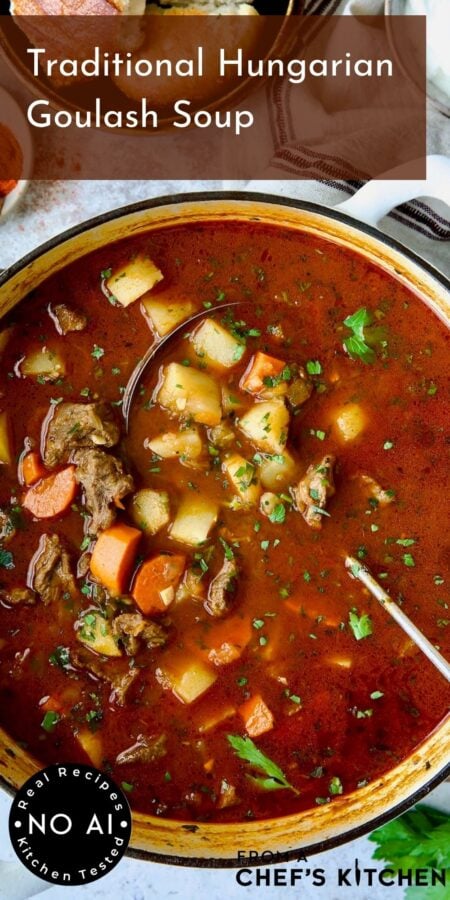
This Goulash Soup recipe is a classic stew, hearty but not heavy, with a warm, smoky-sweet flavor from Hungarian paprika. Tender beef, earthy root vegetables, and a rich paprika-seasoned broth come together for the ultimate comforting meal. Serve with crusty bread, noodles, my easy pumpkin muffins, and my Cucumber and Onion Salad!
“This tastes like my favourite goulash soup from Budapest Restaurant in Toronto!” — Juliette

QUICK TAKE: GOULASH SOUP
- What It Is: This hearty, traditional Goulash Soup is packed with tender beef, vegetables, and plenty of paprika for a rich, savory, Hungarian-inspired meal.
- Ingredient Highlights: Beef, root vegetables, and Hungarian paprika.
- Time to Make: 45 minutes prep and 1 hour and 15 minutes cooking, for a total of 2 hours.
- Chef’s Top Tip: Using too much oil to brown the beef, or crowding it, will cause it to steam rather than brown.
- Why Make THIS Version? My goulash soup delivers all the rich, savory flavor of traditional Hungarian goulash. Generously seasoned with paprika and loaded with tender beef and vegetables, it’s a complete meal in one bowl!
Table of Contents
What is Goulash?
Hungarian Goulash is a soup or stew made with meat and vegetables seasoned with paprika. It dates back to the 9th century. Although it is considered one of Hungary’s national dishes, it’s also served in other Central and Eastern European countries, including the Balkans.
The word “goulash” comes from gulya, meaning “herd of cattle” in Hungarian, and gulyás, meaning “herdsman” or “cowboy,” because the dish has humble origins among herdsmen on the plains tending their cattle. The word gulyás originally meant only “herdsman,” but over time, the dish became gulyáshús (goulash), a meat dish that herdsmen prepared.
Some versions are simply pieces of beef in a rich, savory broth or gravy; others include potatoes, carrots, and other root vegetables; and some add bell peppers or green vegetables like green beans. Every version of goulash shares the delicious pungency of Hungarian paprika.
Why This Goulash Soup Recipe is a Keeper!
I first enjoyed traditional Hungarian goulash in Germany and the Czech Republic, but I became obsessed with it on a trip to Budapest, Hungary.
I brought home two Hungarian cookbooks so I could recreate the wonderful goulash soup I’d enjoyed. However, the goulash recipes differed, reflecting how Hungarian home cooks and chefs prepare this beloved dish in their own ways.
My Traditional Hungarian Goulash Soup combines elements from both cookbooks and another well-established recipe, using ingredients you can easily find at your local grocery store.
If you enjoy traditional Central and Eastern European comfort food as much as I do, try my Golumpki recipe, another hearty, old-world favorite.
This traditional Hungarian goulash soup recipe:
- Has rich, authentic-inspired flavor! Paprika gives this Hungarian-inspired soup its signature deep, savory flavor. Everyday ingredients come together to create something truly special!
- Is hearty and satisfying! Tender beef and vegetables make it a complete one-bowl meal for comfort food at its best! A warming, stick-to-your-ribs soup that’s especially welcome on chilly days.
- Is perfect for making ahead! The flavors keep developing, so it’s even better the next day.
- Is freezer-friendly! Make a batch to enjoy now and freeze the rest for another meal.
Best of all, you don’t need to travel to Budapest to enjoy a wonderful bowl of Hungarian goulash soup! This goulash soup recipe brings the flavors I fell in love with in Hungary right to your kitchen.

How to Make A Traditional Hungarian Goulash Soup Recipe:
Recipe Ingredients:
Here’s everything you’ll need to make this traditional Hungarian goulash soup recipe. See the recipe card below for the exact quantities.

Ingredient Notes and Substitutions:
- Beef: You can use leaner cuts of beef for this goulash recipe, but I used a 3-pound chuck roast that I hand-trimmed and cut into approximately 1/2-inch to 3/4-inch pieces. I ended up with just under 2 1/2 pounds of chuck stew meat. Chuck roast is great for stews and soups because of the connective tissue that runs through it. When cooked slowly and consistently, that connective tissue breaks down, leaving behind tender, buttery beef. Beef labeled “stew beef” could actually be various cuts the butcher or market is trying to sell as remnants, some of which will be tough no matter how long they cook.
- Canola Oil: I used it because it’s what I have in my pantry. If you have lard or bacon grease, use it; it’s more traditional.
- Parsnips: Parsnips are creamy white and related to carrots and parsley. Although they resemble carrots, they don’t taste like them. They’re sweeter than carrots with a nutty, earthy flavor.
- Tomatoes: I used fresh, diced tomatoes because I had them on hand. Use petite-diced canned tomatoes if you don’t have good fresh tomatoes.
- Paprika: Buy good Hungarian paprika; it will make a difference in this goulash’s depth and flavor. Hungarian paprika comes from toasted peppers, then blended into different varieties. All Hungarian paprikas have a rich, sweet red pepper flavor; however, they all range in pungency and heat. Hungarian paprika also adds depth to my Farmhouse cabbage and bean soup with kielbasa and plenty of vegetables.
- Bay Leaves: I used fresh bay leaves in this goulash recipe. If you can find fresh, definitely use them instead of dried; the flavor and aroma are amazing.
- Water / Beef Broth / Beef Stock: This may or may not be true of all Hungarian cooks/chefs, but all the “authentic” Hungarian goulash recipes I looked at used water instead of beef broth or beef stock. I started with half water and half broth to build flavor depth while staying somewhat true to the traditional way goulash is made.
- Potatoes: I used Russets, but Yukon Gold or red potatoes work fine too. In fact, they’re better if you plan to freeze this goulash recipe, since they’re waxy rather than starchy. Starchy potatoes tend to fall apart after freezing and thawing.
Step-By-Step Instructions:
- Gather and prep all the ingredients.

- Generously season the cubed chuck roast with salt and black pepper.

- Heat 1 tablespoon of canola oil, lard, or bacon drippings in a large Dutch oven or other heavy soup pot over medium-high heat. Working in batches, brown the beef well on all sides. Add oil as needed, but don’t use too much or crowd the beef, or it will steam instead of brown. Transfer browned beef to a plate. Repeat until all the beef is browned.

- Refresh oil as needed. Add the onions and celery. Reduce heat to medium and cook for 7 to 8 minutes or until softened.

- Add the garlic, tomatoes, paprika, and bay leaves.

- Give that a stir and cook briefly, 10 seconds or so, until the garlic is aromatic.

- Add the beef back to the pot and stir to coat. Add the beef broth and water. Bring just to a boil, then reduce heat to low and simmer with the lid slightly ajar for 30 minutes.

- Add the carrots and parsnips. Bring back to a simmer and cook 10 to 12 minutes.

- Add the potatoes, bring back to a simmer, and cook 20 to 25 minutes, or until the potatoes, carrots, and parsnips are tender and a knife can easily pierce them.

- Add the vinegar. Let the goulash soup “rest” for 15 minutes or so. Add chopped parsley or celery leaves. Season with additional salt and black pepper, if needed.

- Garnish with a dollop of sour cream, more chopped parsley, and hot pepper sauce if desired.

Chef Tips and Tricks:
- Using too much oil to brown the beef, or crowding it, will cause it to steam rather than brown. You’ll end up with gray or tan beef instead of nicely browned beef. Start with a small amount of oil, and add more only if the beef begins to stick.
- I like to let soups and stews “rest” for 15 to 20 minutes before serving them. After cooking for so long, soups and stews are too hot to eat anyway, so a rest gives the flavors a chance to meld.
- Leftover goulash reheats beautifully, but if you want to get creative, thicken it with flour or cornstarch, put it in a baking dish, then top it with homemade or store-bought pastry for an amazing goulash pot pie! For a shortcut, use store-bought pie crust, just as I do in my cheesy Chicken Pot Pie.
Goulash Soup Recipe FAQs:
Hungarian Goulash is a meat-and-vegetable stew heavily seasoned with paprika. American Goulash is a quick one-pot dish made from ground beef, tomato sauce, herbs, and elbow macaroni. It is also called American Chop Suey.
Absolutely! In fact, it will probably be even better the next day, once all those flavors have melded. Make it up to 2 to 3 days ahead. Cool it completely, refrigerate, and reheat on the stovetop when ready to serve.
Hungarian goulash freezes, thaws, and reheats very well. The potatoes may turn out a bit softer. Waxy potatoes, such as Yukon Gold or red potatoes, hold up better to freezing, thawing, and reheating. If you’re planning to freeze the goulash, cool it completely, then place it in airtight containers in the desired quantity and freeze for up to 3 months. Thaw in the refrigerator, then reheat gently on the stovetop or in the microwave.

Favorites From My Kitchen:
- For a tangy vegetable side, my cider-vinegar-braised cabbage wedges contrast nicely with the paprika-rich broth.
- For another take on slow-simmered beef, my Moroccan Beef Stew combines tender beef with a completely different blend of warming spices.
- Instead of crusty bread or pumpkin muffins, try my savory Zucchini Ricotta Muffins alongside a bowl of goulash.
MORE Beefy comfort!


If you tried my Goulash Soup recipe, please leave a 🌟 star rating and let me know how it turned out in the comments!

Traditional Hungarian Goulash Soup Recipe
Ingredients
- 2 to 2 1/2 pounds trimmed and cubed chuck roast, (1/2 to 3/4-inch cubes)
- Salt and freshly ground black pepper
- 1/4 cup canola oil, lard or bacon drippings, or as needed, divided
- 2 large onions, (3/4 pound) chopped
- 1 large rib celery, chopped
- 6 cloves garlic, chopped
- 4 plum tomatoes, or 2 round tomatoes, seeded and chopped
- 3 tablespoons Hungarian paprika
- 2 large bay leaves, preferably fresh
- 4 cups beef broth
- 4 cups water
- 2 large carrots, or 3 medium carrots, peeled and cut into 1/2-inch pieces
- 2 large parsnips, or 3 medium parsnips, peeled and cut into 1/2-inch pieces
- 4 medium Russet potatoes, peeled and cut into 1/2-inch cubes
- 1 tablespoon red wine vinegar
- Chopped fresh parsley or celery leaves
- Sour cream, optional
- Hot pepper sauce, optional
Instructions
- Generously season the cubed chuck roast with salt and black pepper.
- Heat 1 tablespoon of canola oil, lard or bacon drippings in a large Dutch oven or other heavy soup pot over medium-high heat. Working in batches, brown the beef well on all sides. Add oil as needed being careful not to use too much or crowd the beef because it will steam rather than brown. Transfer browned beef to a plate. Repeat until all the beef is browned.
- Refresh oil as needed. Add the onions and celery. Reduce heat to medium and cook for 7-8 minutes or until softened.
- Add the garlic, tomatoes, paprika and bay leaves. Give that a stir and cook briefly, 10 seconds or so, until the garlic is aromatic.
- Add the beef back to the pot and stir to coat.
- Add the beef broth and water. Bring just to a boil then reduce heat to low and simmer with the lid slightly ajar for 30 minutes.
- Add the carrots and parsnips. Bring back to a simmer and cook 10-12 minutes.
- Add the potatoes, bring back to a simmer and cook for 20-25 minutes or until the potatoes, carrots and parsnips are tender and the potatoes can be easily pierced with a knife.
- Add the vinegar.
- Let the goulash soup "rest" for 15 minutes or so. Add chopped parsley or celery leaves. Season with additional salt and black pepper to taste if needed.
- Garnish with a dollop of sour cream, more chopped parsley and hot pepper sauce if desired.
Notes
- If you have lard or bacon grease, by all means, use it, as those are more traditional.
- Use petite diced canned tomatoes if you don’t have good fresh tomatoes.
- I used Russets, but Yukon Gold or red potatoes also work fine. In fact, they’d be better to use if you plan to freeze this goulash recipe.
- Use a chuck roast and cut and trim the meat yourself. Beef labeled “stew beef” could be various cuts of beef that the butcher or market is trying to sell the remnants of.
- Stir in a dollop or two of sour cream at the end for another dimension of flavor.
- If you want to get creative with the leftovers, thicken the goulash with flour or cornstarch, transfer it to a baking dish, and top it with homemade or store-bought pastry for an amazing goulash pot pie.
- Can be made 2-3 days in advance.
- Cool the goulash down completely, refrigerate, and reheat on the stovetop when ready to serve.
- If you’re planning to freeze the goulash, cool it completely, then place it in airtight containers in the desired quantity and freeze it for up to 3 months.
- Thaw in the refrigerator, then reheat on the stovetop or in the microwave on a low setting.
- The potatoes may turn out a bit softer. A waxy potato, such as Yukon Gold or red potatoes, will hold up better to freezing, thawing, and reheating.
Nutrition
Nutritional values are automatically calculated using unbranded products and are estimates only. Actual results may vary based on ingredients used and portion sizes. Adjust as needed for dietary restrictions, allergies, or health concerns.
 Like this? Leave a comment below!





I was looking for a Hungarian recipe for my husband. I debated between your recipe and a slow cooker recipe. After really contemplating which recipe, since both had great reviews, I was drawn to yours. The final decision was I then realized your name, I think this recipe was calling my name literally. I made the dish last night, and my husband loves it! I decided today to learn more about you and realized there may be a chance we’re related. I’m from Wisconsin also, and my daughter works at a Memphis hospital as a Clinical Manager. Small world indeed, anyways loved the recipe, definitely will hold on it for future family gatherings and a comfort food after a long week at work. Thank you, Mindy Borchardt
Hi, Mindy, Thanks so very much, and I’m happy you and your hubby love it! Wow, it sure is a small world! I asked my husband, but he didn’t recall a relative by your name, but one of his other relatives may. Borchardt is a pretty common German name; when we were in Berlin earlier this year, we went by a restaurant called Restaurant Borchardt. Thanks again, and I appreciate you taking the time to comment.
I just came back from a trip to Hungary and researched authentic Hungarian goulash recipes. Yours is the only one that does not have bell pepper. I just made one recipe and it was very good, but since I’m not a fan of bell peppers, I can’t wait to try yours. Do you consider it to be a nonessential ingredient? Thanks for sharing!
Hi, Rae, Thanks so much for your question. As I mentioned in the post, I purchased two Hungarian cookbooks written in English in Budapest and created my recipe from those; neither had bell peppers. I also don’t recall bell peppers in any goulash I had in Hungary. The paprika, however, IS essential. Just like with most global cuisines, every home cook is going to have their own version–which of course, they deem the best! Thanks again and let me know how this goes for you.
I modified a bit for my Instant Pot:
I browned the beef in batches on a cast iron frying pan so as not to steam the meat (thanks for this tip! I always just threw all the meat into the pan, but now understand about the steam). I used some bacon fat we had leftover from breakfast, and then canola oil as required. I threw the browned beef into my Instant Pot.
I then browned the onion and celery in the same pan after I was done with the beef. I added garlic, tomato, and bay leaves to the pan and then scooped this mixture into my Instant Pot once combined and fragrant.
I didn’t want to miss the toasted spices at the bottom of the pan, so I deglazed with the beef stock and water and added that to the Instant Pot after.
I mixed and then set for a 15 min pressure cook. While this was happening I peeled and prepped the parsnips, carrots and potatoes. I did quick release and then added the veggies for an additional 15 min. I tasted the broth before covering it and added a bit of salt, fresh black pepper and the tbsp vinegar. I did quick release again at the end.
I chose to add about 1/2 tbsp caraway.
This tastes like my favourite goulash soup from Budapest Restaurant in Toronto, which I have been home sick for since leaving for a smaller town north.
Thank you!!
Hi, Juliette, Wow, thanks so much for all this information! I’m sure other readers are going to appreciate it and appreciate your taking the time to come back and comment and rate. Thanks again!
Hi Carol.
Hungarian Goulash recipes elude me. This is the second or third time and it just does not come out tasting anywhere near what I had experienced in Budapest.
I make some extremely delicious beef stews, but this one just can’t get a hang of it. I cook Indian, Thai, Chinese, Greek, Italian, well just about anything from countries I have visited.
I used top ingredients such as authentic Hungarian Paprika, fresh Bay Leaves, fresh ground pepper, kosher salt, etc.
Any suggestions would be appreciated.
Thanks
Max
Hi, Max, Thanks so much for your question. Sorry you’re having a problem replicating an authentic Hungarian goulash. When I posted this recipe (which has 15 4 and 5-star ratings now), I had just come back from an East European tour that included Hungary so the flavor was pretty fresh in my memory. One of our tour members posted a comment that he made this recipe and he also felt it came very close. I revisited the two recipes from the Hungarian cookbooks I used to come up with my version. Two things stood out: They both have cumin in them, they both use lard or pork fat, and one says goulash is traditionally cooked over an open fire. Cumin is not very traditional in Hungarian food and in my years of experience cooking for private clients, cumin can sometimes ruin the flavor for a lot of people so I left it out. The amount used wasn’t terribly much anyway. The only other thing you could try is caraway; I’ve seen online recipes that use it. Did you add any Hungarian hot sauce? I’ll send you screenshots of the two recipes I used and perhaps you can come up with your own version from the two. If you do, I’d love to know what you did because I’m always open to making something better and more authentic. Thanks again!
Thank you Carol. Got the two recipes. And notice the use of Cumin which is a spice that I use in very traditional Cuban Beef and potatoes (Carne con Papas). I used the Sweet Paprika. And I just noticed that I thought I had bought Hungarian Paprika, but instead is Hungarian Style. I have to go back and purchase the right stuff. As you know, the wrong spice can throw things out of wack. For a little kick, I used Indian Extra Hot Chili powder. Not too much, just enough for taste.
The low rating is not about your recipe, but rather my problems with this. Like I stated, this is the second time, so perhaps the third time will nock it out of the pack.
Cheers
Thanks, Max! Glad you got them. Yes, cumin is not traditional and I could just see the purists coming after me for using it. However, now I really want to try it along with possibly caraway. Hungarian paprika is more pungent than sweet so definitely seek that out.
Sorry I left my previous comment before reading your entire post- so my question is unnecessary!
Hope all is well with you and you have continued to enjoy traveling!
Hello from your fellow Rick Steves Eastern Europe tour member and cooking enthusiast! I’m curious if this is Itelka’s recipe…? I didn’t follow up with her to get it.
Anyway, I look forward to trying this one – wonderful memories of our trip!
Hi, Dianne, SO great to hear from you and hope you’re both doing well! When I researched goulash, I noticed how different a lot of recipes are–even in the two cookbooks I purchased in Budapest! So, I came up with my own version using the two as reference and another “Americanized” version so the ingredients were easy to find. Kelly from our trip made it and said it came pretty close to what we had in Hungary! What a great trip! We’re planning a Rick Steve’s trip to Portugal next year. Thanks again!
This is easy and good👍👍Thank you for the recipe.
Thanks so much and so happy you enjoyed!
Hi Carol, I had some of those bowls of goulash with you in the Czech Republic and Hungary and I enjoyed this recipe as much as those. Used the paprika we brought back from Budapest. I plan to do it again and will boost the heat a little bit. Thanks for putting this up.
Kelly
Hi, Kelly, Thanks so much and so great to hear from you! Was just thinking about you the other day and wondered if you had tried my recipe. So glad it gets your stamp of approval. Hope you are both doing well! Thanks again!
I am Hungarian by birth and this recipe is pretty close to mine and mine is delicious. The only thing is that if you put that much hot paprika it would blow your head off. My mom would put in a smidgeon of hot paprika and that was hot enough!
Hi, Judith, Thanks so much for that information! Happy to know this recipe IS so very close to a truly authentic goulash. We brought some hot paprika back from Budapest and didn’t find it that hot but you’re right, no one wants to ruin an entire pot of soup/stew by making it too hot; it’s something that can always be added but not removed. I will make a modification to the recipe. Thanks again so very much!!
What a cozy bowl of comfort! I love how easy this is and paprika wins me over every time 😉 Thanks for sharing!
Hi, Traci, Thanks so much and so happy you enjoyed! I know… the paprika! Especially that Hungarian! Thanks again!